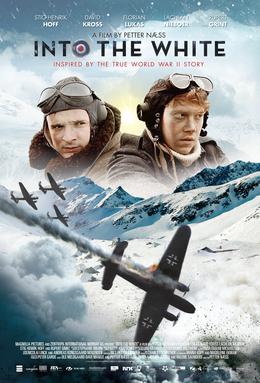
JANUARY 15, 2026 – I’ve said before in a post what bears repeating: “By its very nature, the beast of war brings out the very worst and the very best of humanity.” This evening I watched yet another (superb) Norwegian film (see last Monday’s post)—Into the White—that captures this axiom about as well as any “war movie” I’ve seen.
Released in 2012, however, the movie met with mixed reviews. Representing the negative side, Neil Lumbard in DVD Talk whined:
The entirety of the film revolves around a somewhat simplistic plot element, which is based on actual historical events, but doesn’t engage much beyond the central concept of the film. The film is slow paced and for some audience members this is an obvious detriment.
Fortunately, I hadn’t encountered this review before I watched Into the White, since I take strong exception to Lumbard’s reaction to the film.
First, I would argue that although the plot is simple, it is far from “simplistic.” I found the story and its characters—five in all, plus an ever so brief appearance by a sixth—to be deeply engaging throughout the movie. Rising tension and resolution—usually in three rising arcs—are the sine qua non of any good movie, and Into the White (a bland and uninspiring title, which appears nowhere among the opening credits or scenes) is replete with tension that resolves just in time for another crisis, followed by resolution, to keep the viewer on the edge of the movie room seat. What’s unusual about this film is that the ultimate resolution arrives after the last scene fades and the screen turns black with an economy of words telling us the fate of each of the five characters—German pilot Schopis and two of his crew (the third one having been killed in the crash of their plane), Strunk and Schwartz and British pilot Davenport and his crewmate, Smith.
Second, the setting is also simple, not “simplistic.” Nearly the entire film takes place during the week of April 27, 1940 inside a one-room deserted Norwegian hunting cabin in the midst of blizzard conditions high in the snow and glacier-bound mountains above the town of Grotti, Norway. This settlement, in turn, is about 120 km (as the snow goose flies) from Ålesund, which itself is more or less midway between Bergen and Trondheim. What doesn’t take place inside the rustic abode occurs immediately outside, with a few (film) minutes capturing the Germans’ trek from their crash site to the cabin that appears miraculously out of the hard blowing snow, and the subsequent brief ski outing by Strunk and Smith to reconnoiter possible routes from the cabin to civilization. The viewer is treated to some beautiful panoramic views of Norway in winter, with a special—and very realistic—segment featuring the Aurora Borealis, as Smith sings “Over the Rainbow” while taking an outdoor potty break. The other airmen are drawn outside by his singing and are held in awe by the high-latitude view of the northern lights. Not “simplistic”; simply elegant cinematography.
What pulls characters and setting together, of course, is The War; specifically, the recent German invasion of Norway and the British attempt to counter the onslaught. This punch-counterpunch was manifest in a fight for control of the airspace over Norway, and in actuality—and in the film—one of these clashes between German Heinkel 111s (twin-engine, four-crew member medium bombers) and British Blackburn Skuas (carrier-based, single engine two-seater dive bombers) resulted in a Heinkel crashing on a snowfield in the mountains 3,000 feet above sea level and a Skua going down on a frozen lake some distance away from the downed German plane.
On improvised snowshoes, the German survivors set out across the starkly beautiful, high Norwegian wilderness and serendipitously find refuge in the hunting cabin. By scrounging for combustible starter materials and pulling off a couple of wall boards, they manage to get the wood-burning stove fired up. A short while later, they hear the voices of the two downed British airmen, who, surprise, surprise, seek refuge in the cabin.
All hell threatens to break out, as the tension that previously played out in the sky is now filling the smoky air inside the tiny cabin. At this juncture, the movie really takes off, as the three Germans and the two Brits engage in constant verbal warfare. With the aid of critical props—an ax and Lugers and Enfields (service revolvers)—angry threats risked turning lethal, adding, of course, to the all-critical film element of . . . tension. The imperatives of survival, however, eventually transform bitter hatred into begrudging acceptance, which yields to honest respect and mutual support.
I won’t spoil the reader’s viewing experience by describing the various confrontations between the two “teams,” but to encourage you to watch the film, I should mention in general terms, at least, the more critical themes of the masterful dialogue.
First, the exchanges among the characters establishes the acculturated prejudices of the two camps—the German view of the British as “all show and no go,” and the British view of the Germans as just the opposite: “live by the rules, not by love.” This contrast is illustrated effectively in a colorful debate over German cars (well-engineered) vs. British (far more stylish than German vehicles, but always needing repair). But in many other instances, the Germans speak and behave with ludicrous rigidity, insistence on following “the rules,” and in other regards consistent with many non-German stereotypes of Germans, especially of the WW II era. Likewise, the two Brits (both English) talk and act in conformity with how non-Brits, especially, but probably non-English Brits, too, stereotype Brits (or at least English—upper crust (the pilot, in this case) and working class (the gunner aboard the downed Skua). The film does a fine job of portraying this two-way street of stereotypes.
Second, once having displayed the prejudices that each side carries of the other—and that the film viewer also holds—the characters find themselves exploring behind and beneath their own biases. It’s these exchanges that take the characters—and film viewers—to places far beyond the immediacy of their predicament in the midst of a world war. In discovering just who they are—to themselves and to one another—the five warriors shift from conflict to cooperation; from the devils of their nature to the better angels of their character.
Third, as with smart, thoughtful, quality war films, Into the White turns into an anti-imperial and anti-war movie. By a simple exchange initiated by the question posed by the Brits, “What gives you the right to invade other countries?” we hear the equally rhetorical German response: “What gave you the right to colonize other countries?” With equal directness, we see the belligerent British gunner—Smith—attack Schwartz’s slavish adoration of the Führer: upon returning to the cabin after a case of “the trots” from having eaten a dinner of boiled moss, Smith tosses the German’s autographed copy of Mein Kampf (which Smith had pilfered undetected) back at him and says, “Oh, and by the way, I found chapter two of your book a bit rough on my arse.” Schwartz, of course, is fit to be tied, but without speaking a word, his commanding officer (Schopis) stuffs the remains of the book into the wood-burning stove. This we want to cheer, but the characters display the best of character when Schwartz’s life is in the balance when a minor wound suffered by Schwartz in the plane crash turns gangrenous. This exigency draws out the best of the humanity that is never extinguished in these opposing combatants and in fact, draws them together—a process that underscores the irrationality of war.
As always, war brings inevitable irony and tragedy. Into the White captures this duality—again, simply and effectively, not simplistically and superficially. I won’t spoil it for the reader, but the ending prompts the reaction, “Oh, no! Please, no!” To some extent—but not entirely—the viewer finds relief in the “denouement” that follows the end of the film. To be sure, this is a high-quality film, from the authenticity of details to the excellent writing, acting and directing. My only caveat is that you might want to wrap yourself in a wool blanket while watching this film.
Subscribe to this blog and receive notifications of new posts by email.
© 2026 by Eric Nilsson
