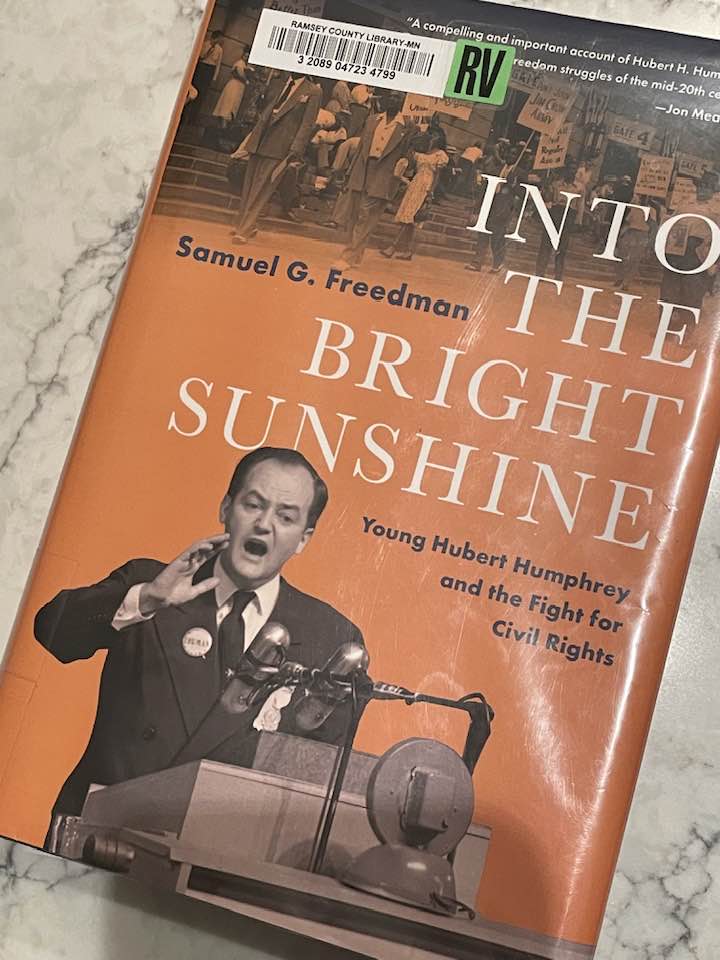
FEBRUARY 4, 2026 – (Cont.) The fight over the civil rights plank of the Democratic platform at the 1948 convention was the capstone of Into the Bright Sunshine. The rest of this riveting book was divided into three parts: a detailed account of the shocking level of racism against the relatively small Black population of Minneapolis in the 1930s and 40s; an equally close look at the disturbing intensity of anti-Semitism in the city during that same period; and an examination of the influences that motivated Hubert Humphrey to become a leading light in the advancement of civil rights in Minneapolis and struggle against anti-Semitism in what one nationally popular writer of the time called Minneapolis: the capital of anti-Semitism in America.
Freedman’s meticulous research combined with his magnificent writing takes the reader on a deep plunge into prevailing conditions during the decades that my dad came of age and entered young adulthood in Minneapolis. Dad possessed a remarkable memory, and he regaled us with ongoing stories of his youth in the city, but we heard nothing of the bigotry toward Blacks or the raging anti-Semitism. One frightful episode—mob cruelty and ostracization against a Black family that bought a house in all white south Minneapolis—was so newsworthy at the time it occupied the headlines for days running, Dad and his parents/my grandparents had to have heard about it. Yet, as a Twin Citian/Minnesotan for most of my life, I’d never heard of this until now.
Many other examples of confounding racism are cited in the book, underscoring the fact that the South didn’t have a monopoly on racial injustice. On the bright side, however, Freedman gives more than passing tribute to Charles Horn, president of Federal Cartridge, Inc. (a major ammunition manufacturer during WW II) and the “Grand Patriarch” of my hometown of Anoka, who hired many Blacks and of those, many in positions of responsibility.
The anti-Semitism that prevailed in Minneapolis—beyond WW II, even, and the full exposure of the horrors of the Holocaust—was downright cringeworthy. From hiring practices that excluded Jews to deed restrictions that prohibited them buying homes, there existed many barriers to equal citizenship. What’s most shocking, is the following that overt haters commanded. The leading “Hater” was none other than the Reverend William Bell Riley of the First Baptist Church, a grandiloquent fundamentalist Christian with a national following.
Juxtaposed to the history of bigotry in Minneapolis was Hubert Humphrey’s remarkably ability to confront it effectively. In examining the overlapping influences that informed Humphrey’s views and actions, Freedman reveals traits that every aspiring young leader should strive to develop. First was exposure. Though Humphrey was a son of the prairie, he was sufficiently outgoing as a young boy to befriend an itinerant rural road builder who was Black. Conversations with this fellow gave the white kid from Doland, South Dakota a chance to see that what was “different” wasn’t “inferior.”
Years later, a university professor (Minnesota) who was well-acquainted with Humphrey’s charisma and intellectual talent influenced a friend and fellow scholar at LSU to take Humphrey on as a graduate student in political science. While living in Baton Rouge, Humphrey became well-acquainted with Jim Crow laws, and the experience would mark the future leader for the rest of his life.
At both the University of Minnesota and LSU, Humphrey forged close friendships and associations with recent refugees from Hitler’s Germany, and these connections, of course, left a profound mark on Humphrey’s outlook on human rights generally and anti-Semitism specifically.
But perhaps the interactions that enriched Humphrey’s political views and motivations would’ve been less profound if he hadn’t grown up with a father who was open minded and intellectually curious, but he was also man of character. The two remained close, and his father was a member of the South Dakota delegation at the 1948 convention. When Hubert, Jr. asked him for political advice in the midst of the critical fight over the civil rights plank, Hubert, Sr. replied, “This might tear the party apart, but if you feel strongly, then you’ve got to go with it. You can’t run away from your conscience, son. You’ve got to go with it.”
Then there was Humphrey’s wife Muriel, who was also a person of irreproachable character. While Humphrey was at the convention, Muriel had made arrangements for the family to get away at a Minnesota lake resort for some much R & R before plunging into his Senate campaign. For Hubert it would be a much needed, much desired respite from the stress of high tension national politics. When Muriel heard that the resort presented to prospective guests a questionnaire including something about “restricted clientele,” she knew that was code for “polite anti-Semitism.” In correspondence to Hubert, she wrote, “If this is true, we cannot go up there for our three weeks stay. It is morally wrong to go there when we believe as we do.”
Though he was a man of great character and exceptional moral and intellectual integrity, Humphrey was not mean-spirited toward his political adversaries. He was willing and able to compromise when he wasn’t compelled to violate his principles, and as he respected his opponents in the Senate, so did the most strident of Dixiecrats reciprocate. In our age of extreme polarization and political vitriol, Humphrey serves as a model of an eminently civil, ever cheerful and highly principled politician. But above all, he demonstrated throughout his life and in all avenues of his life, that what matters most about a person is character.
Subscribe to this blog and receive notifications of new posts by email.
© 2026 by Eric Nilsson
