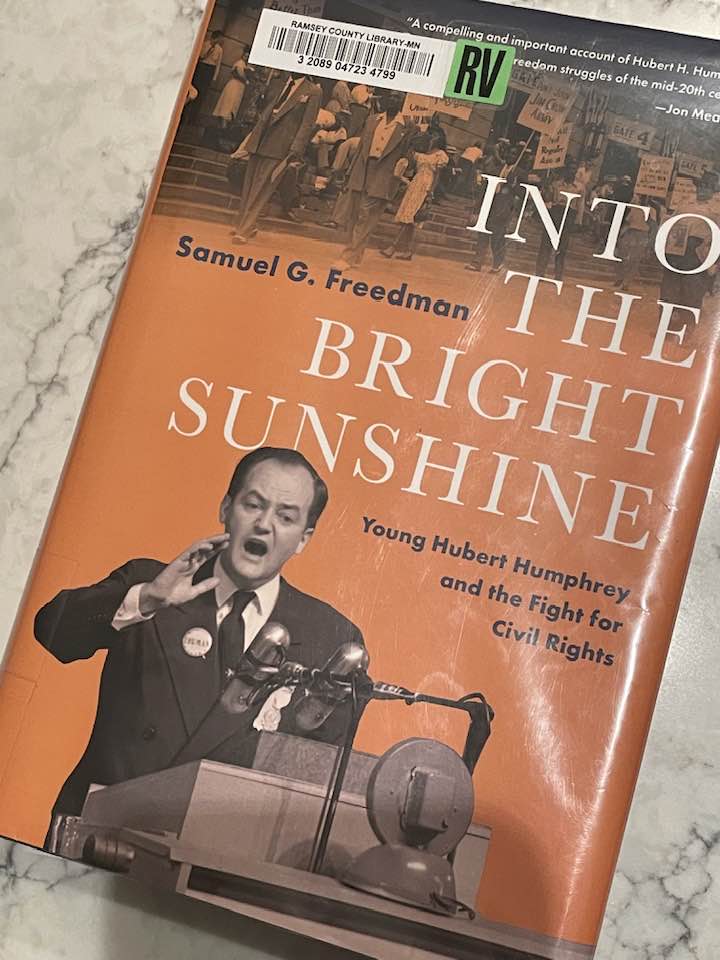
FEBRUARY 3, 2026 – (Cont.) The dramatic conclusion of Into the Bright Sunshine features the clash between advocates of civil rights and protectors of states’ rights at the 1948 Democratic Convention in Philadelphia. In that era, party platforms carried far more weight than they do today, and the intra-party fight over the civil rights plank had been brewing for years. In the run-up to the 1948 convention, the two camps—civil rights vs. states’ rights—had been preparing for a showdown.
The states’ rightists, mostly of the Old South and the Border States, held to a well-defined and long-established position. The Lost Cause still carried influence in what had once been the Confederacy.
People on the civil rights side of the battlefield occupied a broad spectrum. At one “extreme” were Black leaders, who, pointing especially to the patent unfairness and hypocrisy of segregation in the armed forces during World War II and bigotry against Black veterans of that conflict, said “enough is enough.” At the other end of the spectrum were “moderates,” including President Truman, whose tepid support of civil rights was mostly rhetorical. His end of the party feared electoral losses if the civil rights plank in the 1944 party platform—a plank that had been diluted to accommodate states’ rightists—articulated an explicit federal legislative agenda to advance the cause of civil rights.
The fight over the civil rights plank culminated in a floor vote on the minority report of the platform committee, and it was Humphrey who’d played a major role in advancing that position during the platform committee’s marathon debates, machinations, and deliberations. Advocates leaned heavily on Humphrey to deliver the prime-time speech in favor of the report to a plenary session of the convention, but by that stage, he was exhausted and afraid. He knew his future political life (he was already a candidate for the Senate) was at stake. Moreover, at the time of the convention, Truman’s popularity was at an historic low; his own future was very much in doubt. Polls showed that Truman’s prospects for election that coming November were somewhere between horrible and abysmal. If the states’ rightists walked out over anything but a glaringly non-committal civil rights plank, the down ballot Democratic losses would be severe—especially given the likelihood of Black voters and white liberals abandonment of the party in favor of a third party run by left-leaning Henry Wallace (eventual nominee of the Progressive Party; former vice president under FDR (third term); secretary of commerce and secretary of agriculture).
In the end, Humphrey’s closest friends and associates prevailed upon him. He pulled himself together, and the man who by that time had delivered hundreds, if not thousands, of speeches, took to the stage inside a sweltering convention center, and gave the speech of his life—in unequivocal support of civil rights.
He was allotted 10 minutes, and he used all but nine seconds of that time. Greeted by both an outpouring of support and deluge of revulsion, the speech was way ahead of its time and replete with soaring rhetoric:
Yes, this is far more than a party matter. Every citizen [. . .] has a stake in the emergence of the United States as a leader in the free world. That world is being challenged by the world of slavery. For us to play our part effectively, we must be in a morally sound position.
We cannot use a double standard. There is no room for double standards in American politics. Measuring our own and other people’s policies, our demands for democratic practices in other lands will be no more effective than the guarantee of those practices in our own country.
As I read those words, I thought about the double standards of the current Regime and its Republican enablers: on the one hand supporting protesters against the theocrat regime of Iran, and on the other, slandering peaceful protesters in Minneapolis as “paid agitators” in their resistance against brutal and unlawful tactics of ICE agents working at the direction of the Regime.
Humphrey continued:
Friends, delegates, I do not believe that there can be any compromise on the guarantees of the civil rights which [sic] we have mentioned in the minority report. In spite of my desire for unanimous agreement on the entire platform, on top of my desire to see everybody here in unanimous agreement, there are some matters which [sic] I think must be stated clearly and without equivocation . . .
There will be no hedging, and there will be no watering down [. . .] of all the instruments and the principles of the civil rights program.
Then came the kicker:
To those of you, my friends, who say that we are rushing this issue of civil rights, I say to them, we are 172 years late.
To those who say [. . .] that this civil rights program is an infringement on states’ rights, I say this, that the time has arrived in America for the Democratic Party to get out of the shadows of states rights’ and to walk forthrightly into the bright sunshine of human rights. [Emphasis added]
In the event, the states’ rightists didn’t budge, but when the roll call was completed, the minority report passed, 651.5 to 582.5.
Into the Bright Sunshine provides a stunning blow-by-blow account of the eventful Humphrey-led lurch “out of the shadows of states’ rights.” This detailed presentation, however, can be fully appreciated only by careful study of Humphrey’s life, character, personality, education, career and the many people with whom he interacted in all walks of life he encountered. Freedman’s masterful delivery of that background is spell-binding.
By today’s standards, over 75 years later, it seems ludicrous and unforgivable that anyone but the most unsalvageable bigot would oppose integration of the armed forces or treat Blacks soldiers, airmen and sailors returning from the war, as second-class citizens, forcing them back into the world of Jim Crow, denying them fair treatment in employment, education and housing. But because such attitudes were the prevailing ones in 1948, far too many people sympathetic to civil rights for Blacks cautioned “moderation”; “half a loaf” (or less) instead of “no loaf,” no progress. Humphrey was not a member of the “take what we can get” contingent, and though he’d staked out a dangerous position politically, by taking the high road he earned himself a permanent place in the pantheon of American civil rights heroes.
As I considered Humphrey’s courage—and success—I wondered, how many times in our own era are progressives told, “The country isn’t ready yet for your unrealistic ideas”? (Cont.)
Subscribe to this blog and receive notifications of new posts by email.
© 2026 by Eric Nilsson
