FEBRUARY 2, 2026 – On July 6, 2016 Philando Castile was shot and killed by a policeman during a routine traffic stop here in Minnesota. The shooting occurred less than half a mile from our quiet, leafy, liberal—and by way of our complacency, racist—town of Falcon Heights (pop. 5,200). Within a single news cycle, news of the incident travelled around the world. But more than the rest of the world, we libs of this community were shaken out of our blissful ignorance.
So began my personal journey of self-education about the fight for civil rights in this country, reaching back to our origins. With each book read, every documentary watched, I’ve plunged deeper into the tragic record of this unflattering chapter of our history. Less a case of “woke flagellation” and more a matter of historical atonement, understanding the struggle for civil rights is an essential step toward redemption and reconciliation.
It’s easy to be overwhelmed by the mere study of racial bigotry in America, but after the Philando Castile shooting, the residents of Falcon Heights were “taken to school” in the infinitely tougher challenge of living amidst that bigotry. We’d never noticed, for example . . . or more accurately, we’d noticed but not thought anything of the fact that for decades, a disproportionate number of vehicles that police pulled over along Larpenteur Avenue, which bisects Falcon Heights, were driven by Black people. Nor did we even know, that for years, older Blacks knew to avoid that section of Larpenteur Avenue, which runs from the east side of St. Paul all the way to Minneapolis.[1] But discriminatory traffic stops were mere scratches on the surface of our history of systemic discrimination. Not long into the aftermath, we residents of Falcon Heights—where Democrats reign supreme—were reminded that in the chain of title to nearly everyone’s property are restrictive covenants prohibiting the sale or lease to “Jews or Negroes.” These covenants are now unconstitutional and unenforceable, but they reflect history with a legacy that casts a long shadow, and in the case of Philando Castile, led to his untimely and unnecessary death.
The shooting—four years ahead of George Floyd’s murder by a Minneapolis cop—stirred me to fill some of the gaping holes in my education; ironically, an education that included an undergraduate major in American history. I took deep plunges, which included Taylor Branch’s seminal three-volume biography of Martin Luther King, Jr.; The Warmth of Other Suns by Isobel Wilkerson; Slavery by Another Name by Douglas Blackmon; and Robert Caro’s acclaimed four-volume history of LBJ, major chunks of which dealt with racial bigotry and ongoing struggles for civil rights.
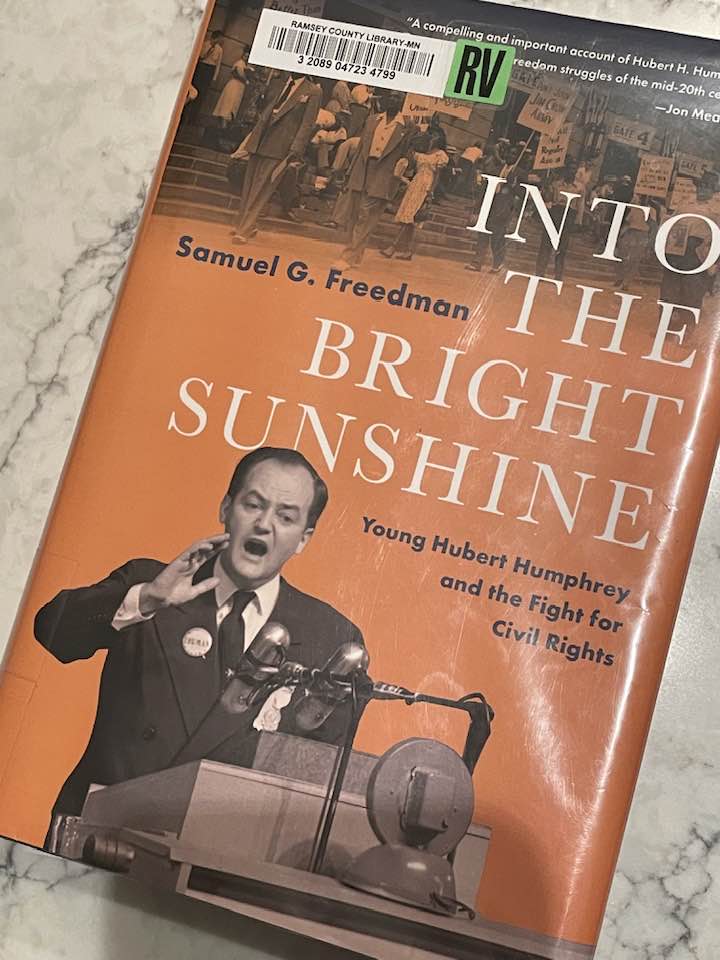
After binge-reading about China and later, the Korean War, I returned to the civil rights front with True Believer, James Traub’s biography of Hubert Humphrey (see 1/11 and 1/20/26 posts). Much of Humphrey’s membership in the pantheon of great American leaders is due to his exemplary record on civil rights. I was so enthralled by the Traub biography, I shot off an email to my fellow book club members, praising the book. As soon as the head of our book club sent a reply stating, “Eric, you may be reading the wrong book,” I realized my error. The correct book, which I identified in yesterday’s post, was Into the Bright Sunshine – Young Hubert Humphrey and the Fight for Civil Rights by Samuel G. Freedman.
This latest book in the category of “civil rights” has opened new perspectives for me, especially against the backdrop of what’s happening in our country today. More on this in tomorrow’s post. (Cont.)
Subscribe to this blog and receive notifications of new posts by email.
© 2026 by Eric Nilsson
[1] At one of the many crowded meetings at city hall in the aftermath of the shooting, we heard the shocking accounts of discrimination by police. Starting years before the Philando Castile shooting, savvier (older) Blacks took circuitous routes to get from the east side of Falcon Heights to the University campus on the other side, thus avoiding the disproportionately high rate of traffic stops of Black motorists in Falcon Heights.
