JANUARY 8, 2026 – When many of us pull one eye away from our newsfeeds, we ask, “How in the world did we get here?” The question is especially freighted with special urgency in the wake of recent ICE actions here in Minnesota.
One response I’ve heard (from white libs, mostly) is, “It all started with the election, then re-election of Obama as president. Racists in this country couldn’t stand the fact we had a Black in the White House for eight years, and so in retaliation, they went for Trump.”
Ironically, to call Obama our first “Black president” reveals deeply ingrained racism to which even self-righteous white libs are oblivious. I mean, Obama’s mother was 100% white Caucasian from the vastly white state of Kansas. But I’ve never heard anyone—right, left or center—refer to the former president as “White.” Moreover, his father was East African, whereas “Blacks” in America trace their lineage to West Africa, at least “Blacks” within the universe of Americans whose lineage was in one way or another burdened by slavery and its legacy—the failure of Reconstruction, the enduring racism of the Jim Crow era, and debilitating de jure and de facto economic/political/social segregation.
But the white libs do have a point in citing the Obama presidency: if they see Obama as “Black,” the bona fide racists—overt and covert—certainly saw him as “Black” (and worse) and viewed his election and re-election as a betrayal of their attachment to a white-washed version of American history and culture.
Nevertheless, to blame the Obama presidency for our current circumstances is too simplistic; too dismissive of the log jam of history pre-dating the advent of a Black president.
Another common response to “How did we get here?” . . . from the right, is, “the Liberal media.” Correction. It used to be, “liberal media”; in recent years, the charge has morphed into “radical leftist media.” From the left, the answer to the question is, “Fox News and Alex Jones, Rush (“to Judgment”) Limbaugh, and their rightwing successors.” From both right and left, the answer to “How did we get here?” is “social media.” (From the center, it’s “online algorithms.”)
Yet, as enticing as media-related explanations are, they’re also flawed. Searing polemics and political vitriol have been staple fare since the earliest days of the Republic. The only difference between past and present mis- and disinformation is the accelerated rate of current publication and circulation.
Another response to the big question here—and one that admittedly, I’ve “fallen for” all too easily—is, “the unprecedented level of ignorance among the electorate.” Note my use just now of “unprecedented.” Lacking energy or word power or both, we who are perpetually squirming on the Trumpian bed of nails resort to “unprecedented.” If you ponder things for long, however, at the same time the details of each nail are unique, the substance of each often does, in fact, have an analogue in the past. Electorate ignorance, as it turns out, has plenty of precedence—every two years, it could be said by losing candidates for Congress and their supporters.
Earlier this year I posted about Howard Zinn’s famous (and depending on your politics, infamous), A People’s History of the United States. Though flawed from a source-reference perspective, the book was extremely helpful in addressing the question at hand—“How did we get here?” I was in the thick of the 678-page tome at the time of Trump’s self-coronation a year ago. Scandalized by the president’s red-meat inaugural speech, I shook my head and let more than a few expletives slip from my tongue. I hadn’t yet observed the destruction by chainsaw-wielding Co-Consul Musk. His campaign rendered me speechless.
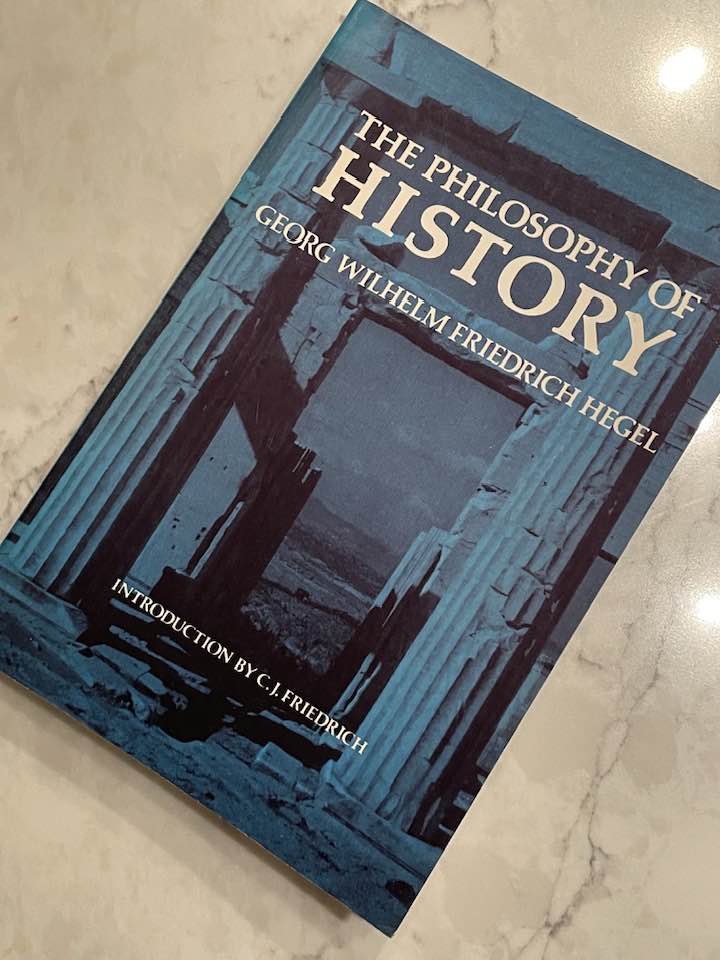
My “Eureka!” moment occurred at the crossroads of (a) Zinn’s magnum opus, and (b) our attendance at the first big anti-regime rally in front of the state capitol. I realized in the middle of that intersection that the best response to the question was an inherent paradox: at the same time the answer was as simple as a single word, the response was also beyond the cranial capacity of a centenarian’s lifetime—cognitive function fully intact. The word—and the impossibly complex response—was . . . history.
Subscribe to this blog and receive notifications of new posts by email.
© 2026 by Eric Nilsson
