JULY 5, 2025 – (Cont.) Sunday evening we and Byron’s family enjoyed dinner al fresco at “Marker 37,” next to the Chester Marina on the Connecticut River. The restaurant name is a reference to the 37th nautical marker (starting at the mouth at Long Island Sound, about six and a half miles downstream). If you know just where to look, you can see the bend on the opposite shore about a mile south of Marker 37. At turn is the entrance into Lower Hamburg Cove, which leads in turn, to Upper Hamburg Cove . . . and Lyme Light.
In any event, Beth got her obligatory annual lobster roll—at “market price,” but a person lives only once, so why not splurge now and again, especially while on vacation. A lobster, of course, would have ample reason to worry about a human wanting to splurge.
The next day we drove to West Hartford to meet Byron for lunch at a Japanese-Vietnamese fusion restaurant a block from his office. Eating, you see, formed a regular theme of our vacation. He then drove us to Bradley International Airport for our flight back to Minnesota.
Our check-in and boarding process was routine, but our gate departure was delayed on account of “paperwork” compliance associated with our calculated gross weight and fuel balance. I wasn’t at all upset by this announcement: I understand the whole business of achieving aircraft balance with fuel, passenger and luggage weight and distribution, and when it comes to safety, I want to be sure that someone is crossing all the “Ts” and dotting all the “i-s.” Aviation safety is all about having and observing checklists and having built-in redundancies in all aspects of the system.
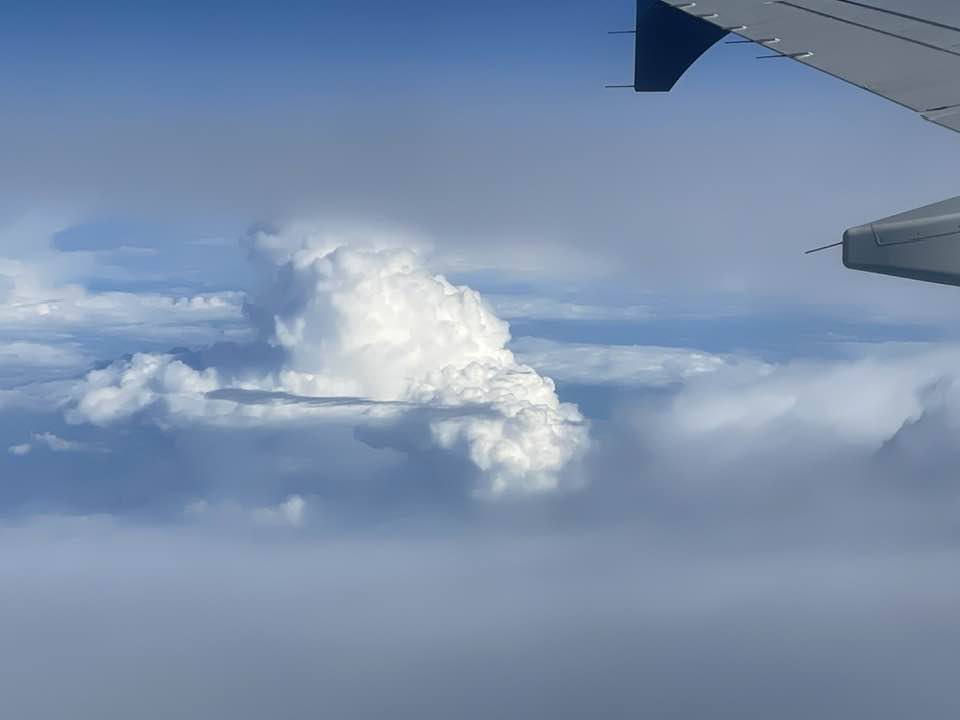
What I did not appreciate was the weather report—severe thunderstorms between our point of departure and our destination. Commercial pilots, of course, don’t go looking for trouble. I knew the plane wouldn’t fly into the storms; it would fly over or around them, but what I’d never experienced before was a flight path that deviated so far from its intended route, we’d be flying well into the airspace of a foreign country. The country was Canada—as you guessed correctly—but not simply over the southernmost part of Ontario, the part that lies between the state of New York and Michigan, but way to the north over Montreal and Ottawa. Though we’d avoid the storms, the captain informed us, we’d likely experience quite a bit of turbulence as we crossed over the northern part of the Great Lakes. I understand turbulence and that experiencing it is no different from driving our pontoon across mildly choppy waters on Grindstone Lake: the airplane isn’t any more likely to fly apart than the pontoon is apt to capsize and sink. Nevertheless, when the plane does start to bounce around, you don’t like to hear the captain say, “Flight attendants, please go to your jump seats for your safety,” which . . . ahem . . . is exactly what we anxious passengers heard.
On the plus side, however, our flight path deviation took us north over the Berkshires, Lenox, Tanglewood and on up over Vermont and into Quebec airspace, before banking off to the west over Ontario. I’d never flown over any part of Vermont before, and being intimately familiar with the Green Mountain State but long absent from it, I was like a kid sitting in an open cockpit ahead of a barnstormer flying a biplane straight over the family farm. How lucky am I, I thought, to have a window seat, flying over one of the most beautiful parts of America the Beautiful! I pressed my nose against the window to widen my view as much as possible as we continued our climb to cruising altitude. To my considerable delight, we flew directly over Killington, the “Beast of the East”—one of New England’s finest ski areas.[1]
I wanted to say to our granddaughter, who was seated next to me, “Illiana, look out there! We’re flying over Vermont!” But she was too engrossed in her game of 2048. Curious about it, eventually, I pulled it up on my screen too, to see if I could move the numerals around as quickly and successfully as the nine-year-old could. As it turned out, no, I couldn’t, so I turned back to looking out the window and reconciled myself to the fact that our otherwise delightful travel companion did not share my obsession with looking out the window whenever I’m aboard an aircraft. What I couldn’t understand, however, is why every single window shade on the opposite side of the plane was pulled down, even though the sun was on our side. No one was taking advantage of the flight path deviation and looking down on the one of the most gorgeous states in the union.
It later dawned on me that the shades were pulled so that passengers could see the screen on the back of the seat in the next row. Have we lost our way, I thought, such that the draw of artificially created amusements—movies, talk shows and whatever else is available among all the “onboard entertainment”—is greater than the miracle of our deep green earth viewable from an altitude of 34,000 feet?
Time x velocity = distance, so eventually our airplane reached the skies over Duluth/Superior. It now followed the same vector assumed by flights from northern Europe to MSP. Many times I’d flown on this route, but each time had been later in the day during summer months, when afternoon-early evening thunderstorms pop up. Yet another time, I lamented to myself, we’re flying very close to Grindstone Lake, and once again scattered rainclouds obstruct my view of that gem, even though (again) I’m on the port (left) side of the plane—and correct side theoretically, at least, to see what needs to be seen.
A half hour later and we were flying over the Mississippi where it flows by my hometown of Anoka, Minnesota. Again, it was a case of “close but no cigar”: Only when I saw the Coon Rapids dam did I find my bearings, but then it was too late. We’d passed Anoka less than a minute before I sighted the dam. “Darn!” I said, but no one heard me.
The final approach and landing were uneventful. I was hugely grateful to be safely back on terra firma. As always, I thanked the flight attendants as I passed them standing next to the galley, and when I turned to exit the aircraft, I said to the captain, leaning against the doorway to the cockpit, “Nice landing and nice flight.” I don’t care how much of flying today is automated. There’s still a human being sitting in the “left chair,” as the pilot’s place is called; a human being with hours upon hours of training and experience and highly specialized skill and knowledge; a human being responsible for operating a hugely sophisticated piece of equipment and getting a load of folks from Point A to Point B safely and securely, flight after flight after flight.
I’ve learned not to take anything for granted; least of all, safety in travel. When we finally crossed the threshold of our back doorway, I said quiet but heartfelt words of thanks for having made it home safe and sound after 17 full and wonderful days away.
Subscribe to this blog and receive notifications of new posts by email.
© 2025 by Eric Nilsson

