NOVEMBER 20, 2025 – The man looked about my age, maybe older, since he was engaged in a way that I would ascribe to someone who was fully retired and, well, definitely older than I am. He was wearing headphones and waders with a skirt of pouches and moving slowly in waters just beyond the swimming area. It was a warm sunny summer day, and my wife and I were sitting on the beach of a small lakeside municipal park, watching our granddaughter swimming nearby.
The man was searching for objects revealed by his metal detector, and every so often he’d reach down and pull from the lake a can, a coin, or some other small but unidentifiable thing that he’d then put in one of the pouches around the top of his waders. When I remarked to my wife that I could think of a lot of things I’d rather be doing than looking for junk by swinging a metal detector over the bottom of Lake Josephine, she issued a mild rebuke. “You can’t speak for him,” she said. “He’s obviously enjoying what he’s doing, and you don’t know that he won’t find what to him is real treasure.”
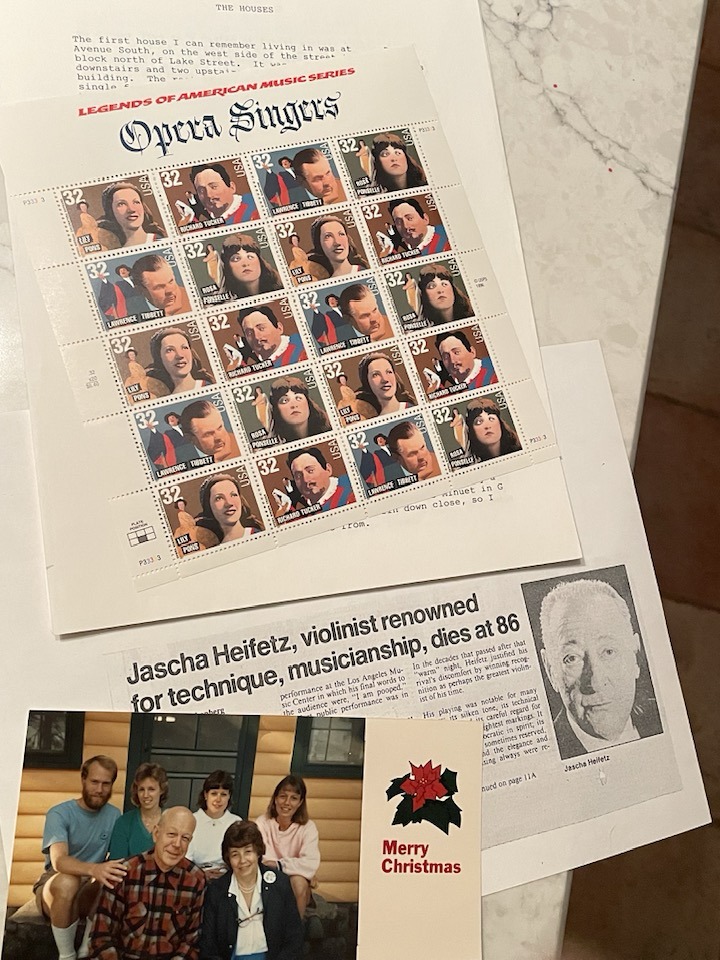
My observation and my wife’s reaction to it came back to me the other day when I was rifling through a box of old files that I’d pulled from storage in our garage. Among various folders, I found what to most people wouldn’t be worth their time but to me were minor treasures: a block of twenty 32-cent postage stamps featuring famous American opera singers under the heading across the top of the block, “Opera Singers” written in Deutsche Schrift; a Christmas card photo from the early 1980s of our parents, my sisters and me sitting on the front steps of the cabin at Björnholm; a copy of a story Dad had composed about his earliest childhood memory (his first steps from his father’s arms to his mother’s outstretched to receive him several feet away); a letter from Mother and Dad to my sisters and me in 1992, inviting us to inform our parents (and one another) what objects around their house we wanted to keep after our parents were “no longer with [us]”; a letter I’d written in 2010 to a close friend, in which I expressed my enduring sorrow over the loss of Dad, who’d died earlier that year; and the photocopy of a newspaper article by Harold Schonberg of The Times in December 1986 after the death of one of the greatest violinists of all time, Jascha Heifetz.
With an admiring smile, I looked over the opera singer stamps, then contemplated how young everyone in the family looked in the Christmas card photo. Next I read the story and the letters, and finally, I turned to the article about Heifetz.
Heifetz was a true gem in our household when I was growing up. Everyone worshiped him as the paragon of violin playing. “Hold your fiddle like Heifetz!” our teacher would preach to me. “Practice until you sound like Heifetz!” our grandpa would say to try (as he might) to motivate me. “No one can play [one concerto or another] better than Heifetz!” any one in our family might proclaim in affirmation of our collective awe of the maestro. His recordings crowded the large collection of LPs in the living room hi-fi cabinet and outnumbered recordings of all other violinists.
When I watch/hear any of the violinists among today’s legion of young virtuosi, I must acknowledge that musical genius abounds, but none looks as statuesque as Heifetz, who stood on stage (and in LP jacket photos) as if chiseled from marble by Praxiteles, and none of today’s whipper-snappers sounds as technically and musically pure as Heifetz. The article gave admiring tribute to the maestro and imparted information I’d never known about Jascha Heifetz, whose single-minded focus in life (so we’d been told) was the violin: he owned a yawl and participated in a sailboat race from California to Hawaii.
I don’t know what treasures the “retired guy with the metal detector” might’ve collected that summer day over a year ago. I do know, however, what treasures I discovered in that folder from the garage last week. But now that they’ve been uncovered, what is to be done with those gems from the past? Who else would think such things are treasures—and for how long before they’re tossed in the recycling bin? How many more “treasures” are to be mined from boxes in the garage and saved or tossed . . . or saved, then tossed? One thing I can bet on confidently: if old papers and images are “digitized,” ironically, they will become as good as lost—soon forgotten deep in a data center somewhere.
Subscribe to this blog and receive notifications of new posts by email.
© 2025 by Eric Nilsson
