OCTOBER 2, 2025 – (Cont.) Our family’s weekend routine back in those days was to leave for the lake as soon as I arrived home from work and changed out of my “lawsuit,” as our older son, Corydon, called my sartorial norm. To hasten our departure, Beth would have the car packed and ready to go. On Sunday evening, we’d reluctantly reverse course and return home for the frenetic week ahead.
Between Friday night and Sunday evening, we divided our time among four places on Grindstone Lake—our own, the two places on Beth’s side (including her parents), and my parents’ cabin at the far end of Björnholm. Because of its easier access from the Red Cabin, inevitably, the first thing Saturday morning—if not Friday evening, depending on how early we’d escaped the cities—I’d jog down the path to say hello to my parents.
Mom would open with her usual litany of niceties. Dad, on the other hand, was like a gold retriever with a tennis ball in his mouth and a tail signaling, “It’s about time you showed up! I’ve been waiting all week for you to throw this ball a hundred yards a thousand times.” What Dad the man would actually say was, “You’ll have to see what I’ve been up to! Come on—I’ll show you.”
With that, he’d lead me to his latest work-in-progress, then launch into a 30-minute monologue covering every detail of the project. I was never sure what was more remarkable—the work itself or Dad’s account of it. One such project—and Dad’s description of it—involved furring strips . . . and a fully annotated demonstration.
By way of background, the old cabin was built in 1940 and therefore, out of real lumber; no OSB or waferboard; no nail guns that fire lame-o fasteners, half the time missing studs and rafters. It was built under the watchful eye (he’d lost the other one in an accident) of Carl Hanson, a local legend when it came to carpentry and all-around wood-working. For some reason, however, the wall between the kitchen and the back bedroom where I always slept was a curtain wall—nicely paneled on both sides with beautiful knotty pine—which didn’t go all the way to the ceiling. The ceiling over both those rooms was simply the underside of the rafters and roofing boards, though at some point when I was very young, roll insulation was installed. This gave me a chance to lie awake early in the morning and see if I could squeeze another word out of the letters spelling, “Fiberglass Insulation Barrier. Do Not Puncture” on the vapor barrier facing downward.
In any event, the absence of any covering over the kitchen and back bedroom—a distinctly unfinished appearance—was incongruous with the rest of the cabin, which had been finished long before I was born. But as is often the case with unfinished works, eventually we become so accustomed to them, we no longer think of them as being in a state of incompletion.
In retirement, however, Dad could devote more time to his Shangri-La. Slowly but inexorably, he addressed conditions at the cabin that had long cried out for attention. During that August many years back, Dad finally tackled . . . the unfinished ceiling.
His idea was simple and in keeping with the floor-to-ceiling wood theme throughout the rest of the cabin. He’d buy a load of three-inch-wide furring strips, work them over, then nail them to the underside of the rafters. He’d space the strips an inch apart for a more aesthetic visual appeal.
What he was so eager to show me was the method he’d devised for transferring a bunch of rough lumber into a highly refined cosmetic feature. In retrospect, it was his form of meditative Zen.
Down in the garage behind the cabin, he had furring strips stacked up neatly next to a couple of sawhorses. Taking one piece of wood from the stack, he laid it across the sawhorses and picked up a small plane.
“Here,” he said. “Let me show you how I work these. First I take the plane and set it at . . . as close to a 45-degree angle as I can eyeball it. I then make one pass—like this . . .” With the same finesse that my grandmother used to butter her toast, Dad applied to shaving a thin slice off the corner of the furring strip. “Then, what I do is turn the plane away from the edge another 15 degrees or so, like this.” He then cut another thin piece off the length of the strip. “I then turn the plan back 30 degrees so I’m 15 degrees to the left of the first pass—like this—before returning to 45-degrees (that’s the ideal, anyway) and making one final run with the plan.
“Next . . .” Dad reached for the sanding block. “I take the sander, using 100 paper, and I sand down the wood until its r-e-a-l nice and smooth . . .” His voice stopped; suspended as if observing a fermata while he moved the sanding block with the same consistent artful motions that he’d applied with the plane. “There. Feel that,” he said, handing me the worked-over furring strip. The wood was as smooth as a kitten’s fur between the ears.
It took him the better part of the following week to finish planing and sanding all the furring strips. By the next weekend he was deep into the varnishing phase, and after yet another week he was nailing the strips to the rafters. To reach them he’d placed a full step ladder on the kitchen table. I felt woozy simply looking at the set-up. Watching Dad conduct a brief demonstration, which included close attention to safety considerations, gave me confidence that he wasn’t putting himself in mortal danger.
Dad was pleased with the ultimate outcome of his furring strip project, and he had every right to be. It marked a vast improvement over waking up to “FIBERGLASS INSULATION – BARRIER. DO NOT PUNCTURE” printed every two feet over the insulation covering.
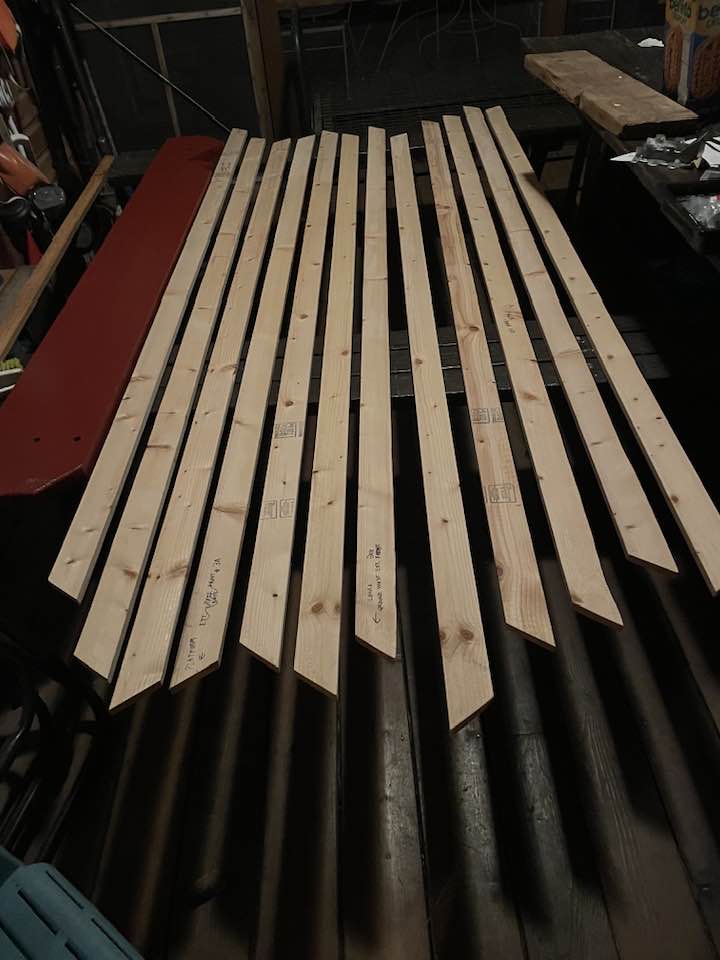
Thus, the reader can understand my amusement when this week I found myself turning 16 rough-cut furring strips into attractive adornments for my Pergola-on-a-Platform project. Dad would’ve appreciated the concept of using “Cinderella lumber,” since it was patterned after his own idea. And I’m sure he would’ve noticed with approval how I copied his angles at 45 degrees, then another 15, than back 30, albeit with a sanding block, not a plane.
Subscribe to this blog and receive notifications of new posts by email.
© 2025 by Eric Nilsson
