JULY 6, 2025 – My good friend Jeffrey Oppenheim. was among the small group that founded the Falmouth [MA] Jewish Congregation in that vibrant Cape Cod community. Today 300 households are among the membership of what has become a robust, dynamic organization, with an impressively educated and experienced staff, a broad palette of educational programs and social and cultural activities, not only for members but for all-comers[1]. One of the many “cool” things about FJC is that in its infancy, local churches donated meeting and worship space, and the East Congregational Religious Society gifted its East End Meeting House (a classically elegant post-and-beam late 18th century structure) and parsonage to FJC—along with . . . drum roll, drum roll . . . a sizable “Teaching and Preaching” endowment.
Ever since I met Jeff the first week of college, I could tell he was destined to be a pillar of the community. Genuine, intelligent, competent, personable, dedicated, Jeff has always been best known by his middle name: Reliable. During our recent sojourn in Falmouth, Jeff drove past the Meeting House (now the synagogue) and FJC center several times, prompting him to give a fascinating account of how things got started.
His story was a reminder of how an encounter leads to a conversation; how the conversation leads to another and yet another; how additional encounters are initiated, followed by more conversations until . . . Voila! Something happens. With more time, thought, effort, and sleeve-rolling, the “something” leads to ignition, followed by “blast-off.” Then comes flight, followed by orbits, and, by gosh, eventually everyone waltzes to the happy strains of “By the Beautiful Blue Danube.”
I’m not what you’d call “a founder,” at least in the manner of Jeff, whose calling, I firmly believe, was to “make stuff happen.” As I reflect on my own curriculum vitae, I wanted to make stuff happen, but in most cases, things worked the other way around. For example, what happened when I “ran” for the job to lead the corporate trust department of Wells Fargo Bank? My principal rival edged me out and fired me!
But a few days ago I received a call from Donna Carlson, the president of our lake association. The annual meeting was on July 5, and she wanted to make sure I’d be attending. Why? Because this year was the 35th anniversary of the founding of the association, and Donna and the board wanted to “recognize” me as one of the founders.
I had two reactions. First was surprise. Thirty-five years in the past was exactly half my life (so far) ago. Though for a dozen years I was highly engaged in the organization (serving as the first president and continuing in that role far longer than I’d originally expected or intended), by the time of the president’s call last week, I’d long ago faded from active participation. That frenetic phase of my life was now a distant memory.
My second reaction was that others deserved recognition well ahead of me. People like Tom and Lorna Gleason, who are “step up, step out, and make things happen” kind of people—and with Beth and me, co-founders of the association; and our late neighbor, Marilyn Buman, who as a former investigative journalist, knew how to uncover facts and information that eluded the rest of us; who, in the days before “online” was a thing or even a word, dug into public records at the courthouse and assembled a mailing list of every property owner (several hundred) on Grindstone Lake; not to mention the many people who followed and over the years, developed the association into what it is today. The Grindstone Lake Association might be analogous to the FJC, I thought, but I’m certainly no Jeff Oppenheim, though I was present at the beginning.
I told the president, that yes, I planned to attend the meeting.
After the call, I took a long walk in the Björnholm tree garden behind the northwest shore of the lake. It was my first time up here our June sojourn in Connecticut. I was overjoyed by the remarkable growth of the pine—some trees having shot up by three feet; some now as high as a house—many hundreds of which I’d planted seven and eight years ago. I was also hugely relieved to see that nearly all the white spruce I’d planted in May during serious drought conditions had survived (we’ve since received an abundance of rain).
As I made my way along the trails, I silently reminisced about the beginnings of the lake association. The trees, I thought, are a kind of metaphor for how things began and later developed with that organization. Just as the seedlings that I’d planted took root and flourished, so did that fledgling association find its bearings and become a critical factor in the effective stewardship of Grindstone Lake, one of the cleanest and clearest in all Wisconsin.
Saturday’s meeting proved to be a wonder. Exceptionally well organized and managed, in both form and substance, it rivaled what I have experienced in most other non-profit, as well as corporate, settings. The agenda was hugely ambitious, but so are the challenges that we lake property owners face. As we heard from one well-informed and articulate speaker after another, almost none of these issues is unique to our neck of the woods. Anthropogenic climate change is not theoretical, certainly not a hoax purveyed by libs or driven by misguided notions of “what’s been going on for millions of years.” Nor is anthropogenic climate change merely prospective. In large part it’s already happened and is accelerating.
What I’d characterize as a “blue ribbon” keynote presentation was given by Dr. Colin Dassow, a fisheries research scientist with the Wisconsin DNR. His 20-minute talk was a short-course in multiple aspects of climate change as it applies specifically to Grindstone Lake and generally to the entire region. He took a multiplex of science and crystalized it into a series of graphs, charts, photographs, and imagery that non-experts could easily grasp. As one might expect, he was a student of facts, a practitioner of analysis, and a guide to perspective. He was also a superb communicator. He oozed with knowledge and intelligence, but he was in no way doctrinaire, condescending or judgmental.
In conversation after the meeting, he informed me that the work of his group is relatively insulated from the political shenanigans of our times, since the group’s budget is funded primarily from licensing fees and other sources unaffected by DOGE-like chainsaws. I applauded his work and thanked him profusely for his excellent presentation.
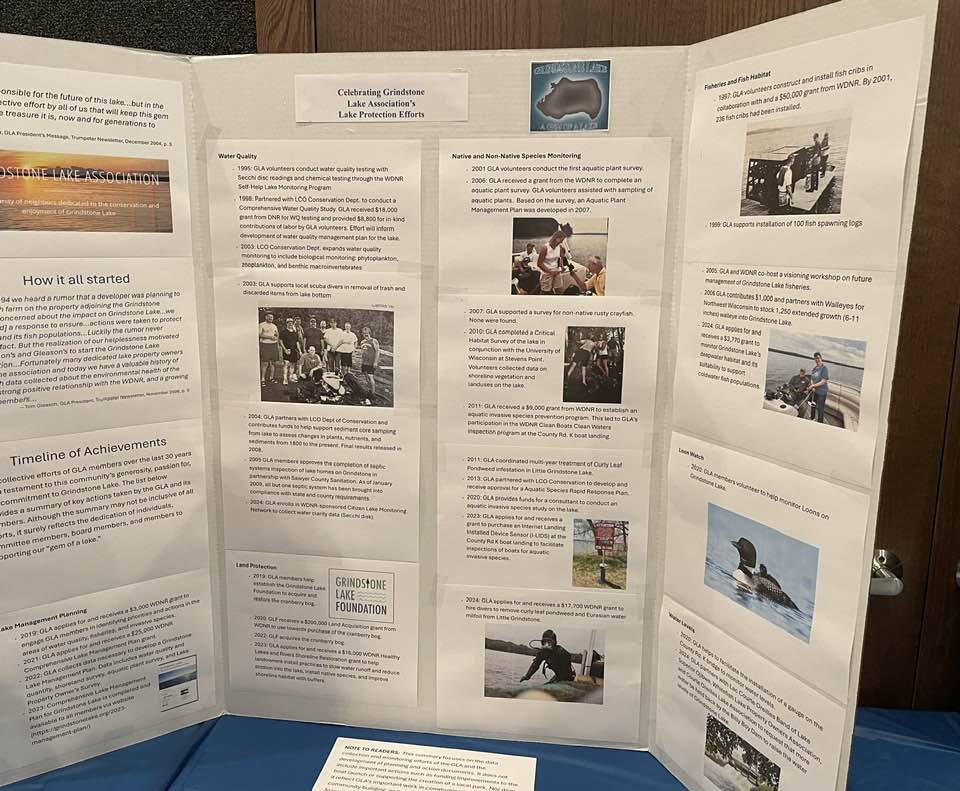
A number of volunteers active in the association gave reports on other matters and referred to the various informational displays that surrounded the perimeter of the meeting hall (inside the local Mennonite Church). Each of the speakers and displays imparted critical information. If the lakes and land of this region are under siege environmentally, the good news is that people are waking up to the alarms.
Back in the day, a crisis served as the catalyst for our formation of the association. That crisis was a proposed fish farm to be located on the east shore of the lake. The way Lorna Gleason remembers it is that I called her to sound the alarm. The way I remember it is the other way around. In either case, our joint lobbying efforts defeated the proposal. Once the crisis was past, we wondered what the next environmental threat would be and how we’d be able to respond. From that discussion we realized the need “to organize” on a sustainable basis, and the first step would be to establish a lake association.
Back then, no one had much heard of climate change, let alone worried about it. I, for one, was abysmally under-educated in environmental science. I’m still under-educated, but after Saturday’s “short course,” I’m far better informed than I was when fireworks were lighting up distant horizons the night before in celebration of the words of another sort of Founder.
Subscribe to this blog and receive notifications of new posts by email.
© 2025 by Eric Nilsson
[1] One of the many “cool” things about FJC is that in its infancy, local churches donated meeting and worship space, and the East Congregational Religious Society gifted its East End Meeting House (a classically elegant post-and-beam late 18th century structure) and parsonage to FJC—along with . . . drum roll, drum roll . . . a sizable “Teaching and Preaching” endowment. Talk about community good will!
