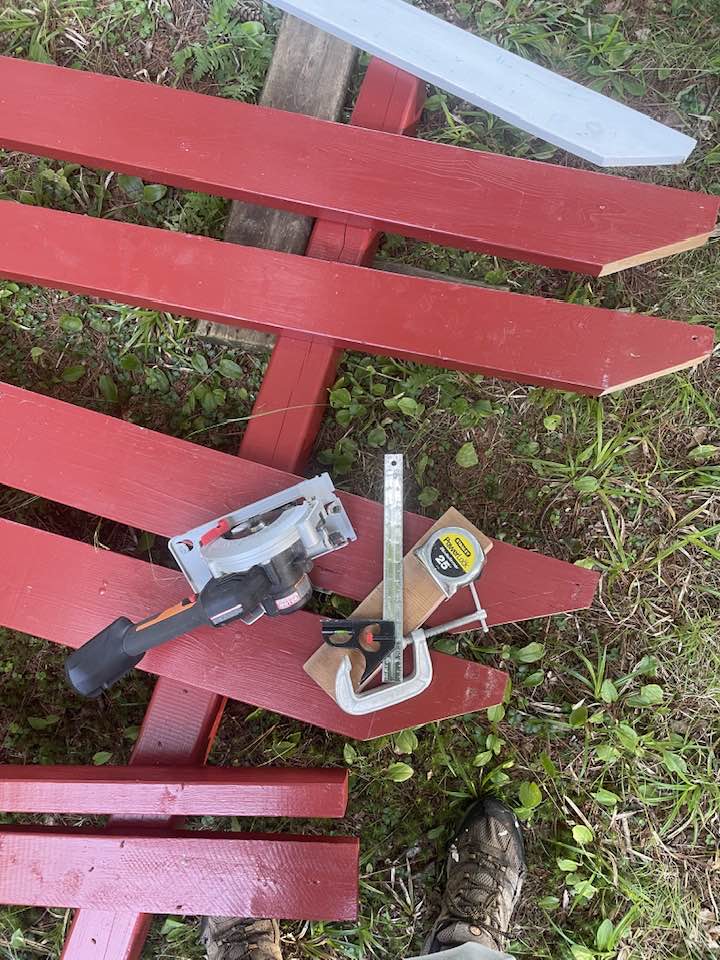
JULY 19, 2025 – Yesterday I had to make cuts at the end of the beams that will support the purlins of my Pergola-on-a-Platform. The beams are two-by-fours, I didn’t dare make the cuts with the only power saw I have available right now, a battery-operated mini-circular saw. I turned to my hand saws and with the use of a square and angle-finder, I drew my lines and started my cuts—top and side and lining them up to ensure that the cut would be as square as possible. I then finished the cuts by plunking the two-bys on the dock (with a slight overhang), where I could get better leverage. This method worked but less than perfectly, and only after 10,000 push-pulls of the saw.
Last night I woke up after an intense dream, and found my thoughts turning immediately to the remaining pieces of the pergola that must be cut in the same style as the beams. These additional pieces were two-by-sixes, thus requiring 50% more push-returns with the handsaw. Moreover, there were twice as many boards to cut. I had to devise a way to use the circular saw—for efficiency, as well as precision.
An experienced carpenter could solve the problem in his sleep. As a rank amateur, I had to be fully awake. But as I sat up in bed, the solution came to me: I’d devise my own fence; take a C-clamp, attach a fence to the plank I’m cutting, and run the saw plate along the fence. No, not the sort of fence that makes good neighbors, but one that serves as a guide for a saw. Having solved the problem, I returned to my dreams, which were doozies.
This morning I assembled what I needed to mark my cutting lines—square, pencil and tape measure—and used a C-clamp and two small pieces of three-quarter-inch scrap wood to fashion a simple but perfect fence. With little effort the job was completed, and I was pleased with the result.
What gave me special pleasure was the simple applied math—third-grade geometry and fourth-grade algebra. Well, okay, maybe fourth grade geometry and fifth grade algebra. In any event, I experienced great satisfaction in deployment of the Pythagorean theorem and using algebra to compute proportionality of “embellishment cuts” between braces of different widths.
My favorite piece of applied math, however, was the simplest: drawing a line parallel to an existing line. I executed this elementary task by marking a point at right angles 7/8ths of an inch distant from my first line and marking a second point in the same fashion, then connecting the two points. As I drew my pencil along the straight-edge, I recalled the day when one of my grade school teachers informed us that on a line are an infinite number of points. What a cool concept! I thought—then and today.
The older I get the more delight I find in simple works—as simple as a fencing operation.
Subscribe to this blog and receive notifications of new posts by email.
© 2025 by Eric Nilsson
