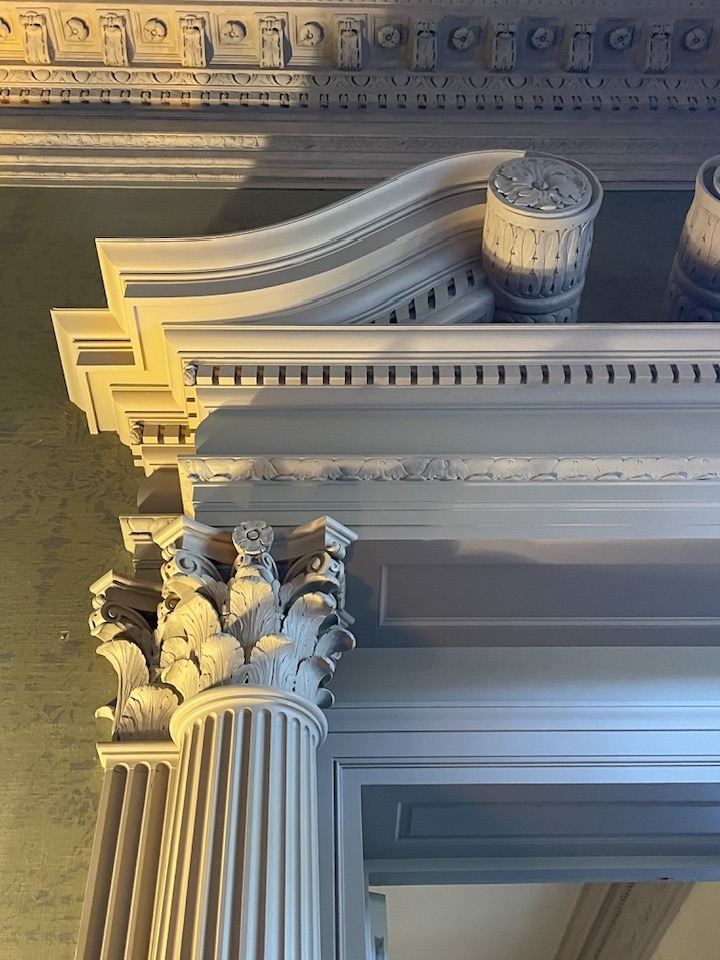
NOVEMBER 3, 2025 – On this fine day in the city, we left it in favor of a tour of the “Filoli Historic House and World-Class Garden” in rural San Mateo County, 40 minutes and 100 years south of San Francisco. I’d visited the attraction a little over 45 years ago[1], five years after it had opened to the public. Today the place offered a far broader range of attractions, including a temporary outdoor exhibit of Thomas Dambo’s amazing TROLLS[2] and a legion of Halloween-style pumpkin-headed cleverly clad scarecrows, and astonishingly detailed Halloween-themed props and decorations inside[3].
The centerpiece of the 600-acre Filoli estate[4], which figures in the sets of a long list of movies and the famous Dynasty 1980s TV series, is a Georgian-style mansion built by Agnes and William Bourne during the time most of the rest of the world was pre-occupied with WW I: started in 1915, construction was completed in 1917 at a cost in today’s dollars of $11 million. The dwelling was but one of many the Bourns owned in California. Their wealth was inherited and emanated from California gold and later, William Bourn’s astute investments in water and gas utilities. After the Bourns died in 1936, the spread was sold to the Lurline and William Roth family, whose source of wealth was the Matson Navigation Company. In 1974 Lurline Roth donated the place along with a hefty endowment to the National Trust for Historic Preservation.
As does any other monument to extreme wealth, Filoli stirs all kinds of thoughts in the heart and mind of the visitor. According to my expert (please get a grip on your laughter) observations, mega-wealth changes people, and whenever I encounter the material legacy of an über-rich individual or clan in “olden times,” I wonder how extreme wealth colored their world view.
In the case of the Bourns, I was quite ready to label them as “robber barons” whose riches were amassed in large part by monopolistic control of an essential public asset—water. But just then I held back. If I were to condemn William Bourn for his self-aggrandizement at the expense of others (not only by providing them benefits), I would create a conflict with myself: I was having a perfectly delightful time touring the mansion, the gardens, and the woods beyond—a highly pleasing aesthetic experience—that once belonged to Mr. Money Bags. Moreover, I felt inclined to cut him some slack when I learned that he and Agnes lost their only son when the boy was barely one and lost their only daughter to pneumonia when she was a young adult. Bourne himself suffered a stroke five years after Filoli was finished and spent the last 14 years of his life in a wheelchair.
From a broader perspective, the visitor is also forced to contend with the now standard “land grab acknowledgment”; a plaque, a website page, or some other written pronouncement that “The landmark/restored buildings/performance center are located on land the indigenous people occupied and [it inevitably follows] considered sacred.” Though there is talk about “cooperative actions” between today’s “heirs to a tradition of exploitation” and the descendants of the native people who were driven off their land, I have yet to see anything about today’s power structure proposing to surrender all their post-Columbian gains. What I call the “land grab acknowledgments” are fine, but they’re all too glib and superficial to do much substantive good beyond assuaging guilt—in the moment—of white libs. Nevertheless, one is forced to do more than acknowledge history. We must ponder the active roles played by our social and cultural ancestors. We must examine the moral and ethical frameworks in which they operated and how and why the prevailing standards—and departures therefrom—should inform the moral and ethical rules that we establish for ourselves now and into the future.
What we should celebrate today, I think, are the efforts and contributions of so many people who render Filoli a vibrant, beautiful, invaluable resource and tranquil refuge for over 400,000 visitors a year. On our way out of the mansion after a delectable lunch at the pleasant café, I stopped to talk with a member of the large staff that does such a marvelous job of maintaining the grounds, gardens, mansion, and ancillary buildings. He was a man perhaps 30, a history major in college, and currently pursuing his masters in museum studies. He worked mostly in the remarkable gardens and was not only enthusiastic about his work but eager to promote the mission of the organization behind Filoli today. We talked for quite a while about reconciliation of conflicts between present mores and attitudes and actions of the past. I was quite heartened by his optimism about the future. Mentoring younger employees and reaching out to visitors, this fine gentleman told me confidently that “95% of the people who come through here are really good people.” He made a point of reaching out to visitors, even though that wasn’t an expectation that came with his job.
As we departed the grounds, the vote was unanimous among the group: our time at Filoli had been well spent.
Subscribe to this blog and receive notifications of new posts by email.
© 2025 by Eric Nilsson
[1] Accompanied by Russ’s grandmother and uncle.


[4] “Filoli” is an acronym formed from the first two letters of the verbs in William Bourn’s motto: “Fight for a good cause; love your fellow man; live the good life.”
