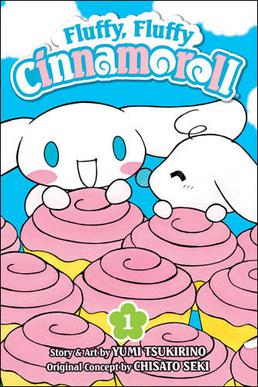
AUGUST 31, 2025 – (Cont.) My third example of a false assumption—memorable because it occurred just a few days ago—involved our granddaughter. The catalyst was her favorite Japanese animation character. Allow me to explain . . .
Last Monday evening Illiana stayed overnight with us so we could take her to the Minnesota State Fair the next morning—the extreme northeast corner of the fairgrounds being a half mile from our front door. Before she trundled off to bed, she brought up the subject of Cinnamoroll—the main character (a white puppy with pink cheeks, long ears, blue eyes and a cinnamon-like tail) in the popular eponymous Japanese cartoon series. Just to be difficult, whenever our granddaughter appears in her full Cinnamoroll hooded robe, I exclaim, “Oh my gosh! It’s a cinnamon roll again!” And each time she corrects me, saying, “Grampaw! It’s ‘cinna-MOROLL,’ not ‘cinna-MON-roll.” To which I reply, “That’s what I meant—‘cinna-MON-roll.”
In any event, after our usual exchange over ‘cinna-MOROLL,’ I asked Illiana is she’d like ‘cinna-MON-rolls’ for breakfast. What I had in mind were not the prize-winning cinnamon rolls that my grandmother made every time we visited (except she ruined them by adding raisins, which I never liked, though I never told her so). No, the cinnamon rolls I’d imagined were the ones (without raisins!) that come in a long, narrow cannister. They’ve been the mainstay of my culinary repertoire as long as I can remember. They’re impossible to screw up, and with melted butter liberally applied and extra strong coffee all gussied up with flavored cream and Ovaltine, cinnamon rolls out of the can are a great way to start a Saturday or Sunday. Those are the two days on which I’ve customarily indulged in cinnamon rolls, but under the circumstances that arose Monday evening, I figured it would be fun and appropriate to serve them up on Tuesday morning.
My favorite version of cinnamon rolls in a can, however, are the ones with orange-flavored frosting. Suddenly I had a serious hankering for them, but I knew that I should first check with our guest to gauge her reaction. The answer was a resounding no. Fine. I could handle it. Regular frosting it would be.
The next morning I rose extra early and dashed off to the store to buy the familiar cinnamon rolls in a can. The mission plan was concise and compressed: locate the cooler where rolls in a can are stored, look for cinnamon rolls, grab a cannister, head for the self-checkout to pay, and dash back to the house, all before our overnight guest had emerged from dreamland.
My plan was to turn the oven on the moment Illiana appeared downstairs. By the time the oven temperature hit 400F plus 15 minutes, she and I would be happy campers, indulging in fresh-baked cinnamon rolls, (regular) frosting and melted butter dripping down the sides.
Before long, the little girl appeared, happy to see Grandpa following through on cinnamon rolls for breakfast. She took a stool at the kitchen counter to watch the proceedings and nibble on the fresh strawberries I’d previously washed and cut for her. In the usual fashion, I pulled the tab on the side of the cinnamon roll cannister, stuck a spoon in the seam of the thin carboard wrapper, and . . . POP! The cannister broke open, just as it always does. I gently removed the rolled up dough and carefully separated one roll from another. After arranging them in the prescribed fashion in a lightly greased circular baking pan, I stuck the pan in the oven and set the timer.
Meanwhile, I searched the bottom of the cannister for the all-important plastic container holding the frosting, with its easily removable metal cap. Except . . .
“What’s this?” I asked disapprovingly. “There’s no cap on the frosting container.” Worse yet, I explained to the ever observant Illiana, the frosting is in a little plastic bag. What in the world?”
Generally, around Illiana I’m watchful about revealing my curmudgeon tendencies. Under no circumstance do I wish to be remembered as a grumpy grampaw, who was living very much in the past viewed through a rose-colored lens and contemptuous of all things “new and improved.” And yet . . . and yet, even the younger reader must acknowledge that on occasion, the newfangled deserves to be criticized; to be called out for corners cut, quality compromised, and standards diminished. This was most definitely one of those occasions. The circumstances didn’t simply call for an “assumption.” They were clear enough to render assumptions unnecessary and even inappropriate. What was before us—new but vastly inferior packaging—needed to be called out for what it was by any objective gauge.
So I did. “How in the world,” I started in, “are you supposed to spread the icing when it’s delivered up in a dinky plastic bag? I mean, Illiana, just look at this,” I said, as I disgorged the lame packaging from the cannister. “How are you supposed to take a knife or spoon and coax the contents out of this ridiculous little bag? Why isn’t the frosting in the mini-tuna-sized plastic can with the metal cap? You just remove the cap, stick your spreading knife into the frosting, then goop it onto the cinnamon rolls.”
Illiana looked on intently but silently, her cheeks held up by her fists and her elbows—still pajama-clad—leaning on the counter.
“You know, Illiana, some things just aren’t as good as they used to be,” I said. What coursed through my thoughts were all sorts of curmudgeon-like cynicism about . . . “the system.” The system that’s out to short-change us, wringing out expenses wherever possible, jacking up prices, expanding profits and adding to the misery of the common folk. It made me think of Howard Zinn’s A People’s History of the United States and his thesis that in the end, capitalism will eat us alive. To Illiana I said more “grumpy grampaw” stuff that can be accurately abridged as, “Grrrrrr . . . hurrumph!”
When I glanced at Illiana’s innocent face, however, I caught myself. “No more grumpy grampaw!” I said to self. “Put your happy face on and turn this into a positive teaching moment.” And I did—not realizing that I was headed for a destination other than what I’d assumed.
“You know, Illiana,” I said, “sometimes when we’re faced with something we don’t like—such as an adverse change in how the frosting is packaged—we have to adapt. We have to accept that things aren’t as we’d prefer and make the necessary adjustments.”
No sooner had I said this, than a critical detail in the packaging design came to my attention. The packaging engineers had not, in fact, cut corners unconscionably to increase corporate profits at the consumer’s expense. They had redesigned the whole plastic frosting container with the (all too) easily removable metal cap. They’d substituted the plastic container with a thin-walled cardboard holder in which the bag of frosting was confined. The bag was plastic too, so that material hadn’t been eliminated, but in size and weight it was a small fraction of the old plastic container. The metal cap was dispensed with altogether. Most important, the plastic bag of frosting contained a small spout, which when snipped with a pair of scissors, could be used (when the bag was squeezed) to spread the frosting very evenly and without any waste, over the cinnamon rolls. Moreover, there was no need to use (and later wash, after its sticky contents had mucked up the countertop) a spreading device of any kind.
In this epiphanous moment—that the “new and improved” frosting packaging was in fact, indisputably improved—I realized that my “teaching moment” was different from what I’d originally . . . assumed. Yes, I supposed that the whole business about adapting was good, fine, and decidedly non-grumpy, but the bigger lesson, I realized, was about invalid assumptions. I adjusted course accordingly.
“You know, Illiana, what just happened to Grandpa is worth talking about. At the outset, if you will recall, I was disapproving of the new way the frosting was packaged. Remember? I had assigned some nefarious motive to the people designing the package—and if not nefarious, then just dumb, ignorant, and inferior. I was certain that for whatever reason, quality had suffered because the old design had been discontinued. But once I examined the changes, I realized they marked a substantial improvement.
“All of which goes to show, Illiana, we should always question our assumptions. So often we assume things that simply aren’t right or correct. And that, sweetheart, is the unexpected lesson to be learned from the frosting packaging that came with this set of cinnamon rolls.”
Before anyone else in the house—namely Grandma—knew it, the cinnamon rolls, frosting and all, were . . . gone, and the three of us were off to the fair.
Subscribe to this blog and receive notifications of new posts by email.
© 2025 by Eric Nilsson
