DECEMBER 28, 2025 – I come from a family of characters, who in one way or another have found a relatively clutter-free entrance onto the great highway of life and worked their ways over to the cruise-control lanes of “through traffic.” Good for each of them—for excelling in school and training; for finding their callings; for never having to drive a “lemon” that was made on a Monday or a Friday. I long ago gave up my envy and learned to appreciate my four-cylinder commuter car with stubborn pine sap on the windshield, a cloudy lens on the back-up camera, and scrap lumber in the trunk, finding my way through local traffic in the “Downtown Exits Only” lane.
But there are two members of the family who deserve special mention, not because they’ve commandeered the steering wheel (and gas pedals) of a Lamborghini in the fast lane, but because they’ve demonstrated dogged persistence and determination in the pursuit of excellence and are finally achieving recognition for their efforts.
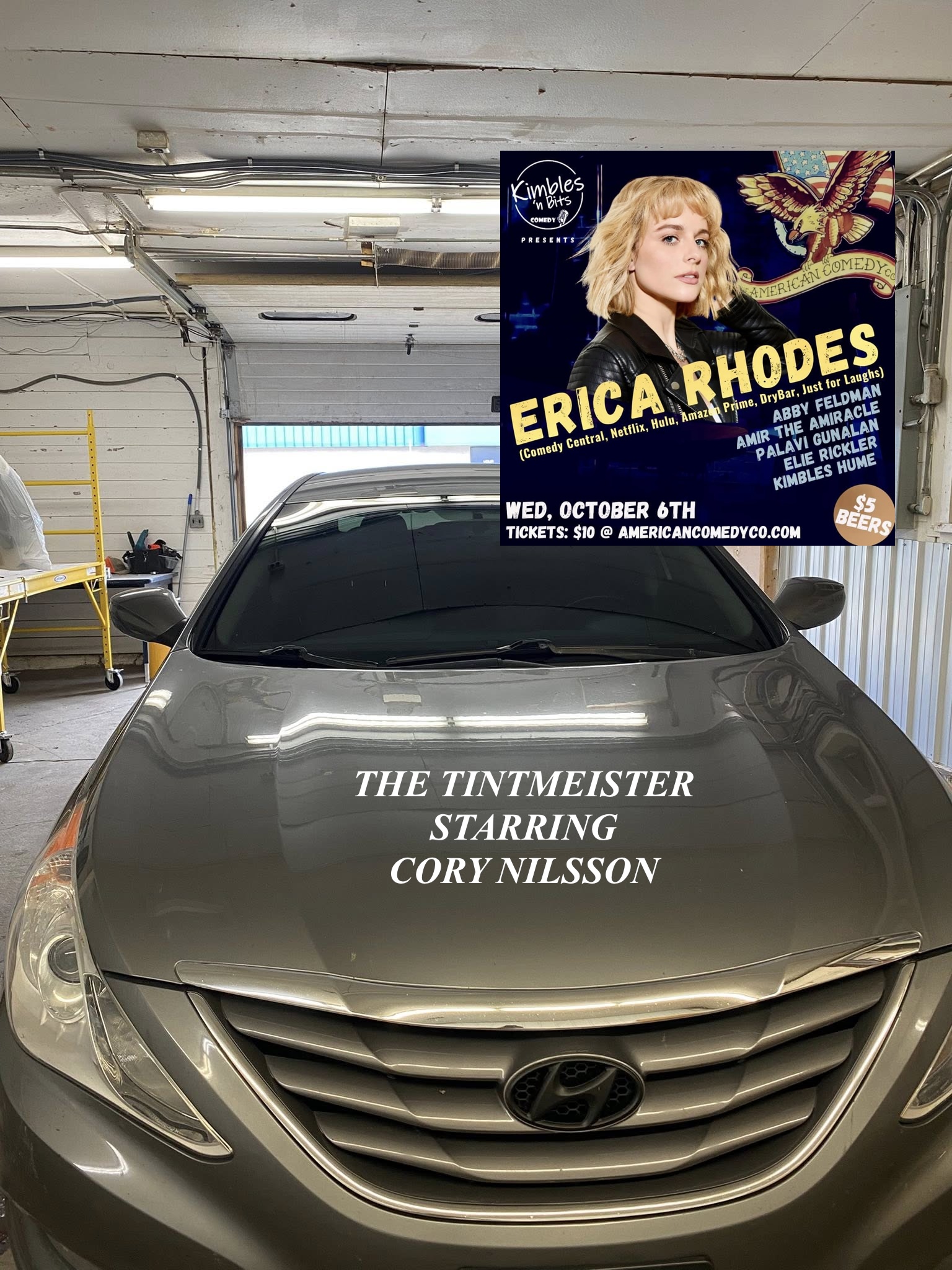
The older of the two is my niece and namesake Erica Rhodes, a stand-up comedian. Her early connection to comedy and lifelong inspiration was her father, Dean. Dean started out as a professionally trained clarinetist, who performed as a free-lancer in Boston. When he grew weary of gigging, he left the free-lance music world to his wife—my oldest sister—and went back to school and became a CPA. Eventually, he wound up in the fast lane as a tax accountant extraordinaire at a “Big Eight” firm, where he could see nearly to the Berkshires from his high-elevation office in the John Hancock Building in downtown Boston.
Throughout his music and accounting careers, Dean was the consummate comedian, always telling jokes and exhibiting a reliably wry sense of humor. His amazingly “funny side” seemed to work in inverse proportion to the growing ravages of MS, which ultimately forced him into early retirement. His gift for humor, his ability to laugh at life, became Erica’s special inheritance—her fuel and fire.
But she wasn’t a jokester when she left the nest. No. She was a cellist—not a violist, about which, jokes abound, as Erica’s aunt, my sister Jenny (a professional violist), knows all too well. First a student at Boston University, she later moved to New York to study with Ron Thomas, the renowned performer and pedagogue and friend/colleague of my three string-player sisters. But what Erica wanted most was to become an actress, despite her parents’ desire for her to find a vocation that might—just might—pay a living wage.
Battles ensued. I remember at one point my sister suggesting quite seriously (it seemed) and in exasperation (most definitely) that Erica should “join the army.” During that same critical time, Dean worried aloud that “Erica might wind up living under a bridge,” and I could tell from his tone that he wasn’t joking.
This sort of parental encouragement was all Erica needed to continue—enthusiasm unabated—down her chosen path. She quit the cello and redoubled her efforts to break a leg in the film industry. In time she won a few parts. In the process she developed enough skill to win regular spots in skits on A Prairie Home Companion shows. She moved to L.A. and shifted her focus into comedy, specifically, stand-up.
Success wasn’t a straight path. As any struggling stand-up comedian can attest, the gig is often not so fun or funny. The competitive and personal financial challenges are anything but intrinsically humorous. Erica’s parents, being parents, continued to worry about her. We all did—with one notable exception: the “Tintmeister.”
If any of us (other than the “Tintmeister”) had woken up in Erica’s shoes, we would’ve raced to the nearest exit, even if it meant joining a massively amorphous traffic jam of banality and broken dreams. It seemed that she would never understand—as her parents thought they did—that she needed to acknowledge that the gas gauge showed “empty.”
Fast forward to today: by her determination and extraordinary work ethic, Erica has earned her place “headlining” shows at comedy clubs across the country and high-visibility appearances on television. I knew she’d “made it,” when about eight years ago, a business client of mine called me one day and asked if I happened to be related to a comedian named, “Erica Rhodes.” He followed several stand-up comedians, he disclosed, and had stumbled across one of Erica’s extended online clips. The client knew enough about me and our family, and Erica’s jokes revealed sufficient information, for him to put two and two together.
“Yes,” I said, proudly, “as a matter of fact, Erica Rhodes is my niece.” My client raved about her jokes and delivery and said he thought she was “every bit as good as the big names.” I felt great familial pride—and relief that Erica hadn’t joined the army.
The “Tintmeister,” is what I call our son Corydon (“Cory”), Erica’s second-oldest cousin. Tremendously gifted, Cory has struggled mightily in life, often constrained by “analysis paralysis.” Bored in elementary school, he quit applying himself in middle school and skipped through a high octane high school in preparation for bombing spectacularly out of college. By a combination of necessity and opportunity, he landed a job in a vehicular window-tinting shop and found his niche.
The problem is that he’s always worked for establishments in the running for the “Worst Mismanagement Award – Tarnished Medal Division.” These subpar outfits seemed to center on economic exploitation of employees and suboptimization of business opportunities, not to mention the worst—faulty equipment leading to Cory’s serious injury. Despite an unrivaled work ethic—when given the chance to work—he never got his chin much above the waterline. Along the way, however, he developed unrivaled skill and industry knowledge.
In the late 2016 when Philando Castile was fatally shot by the police—a half mile from our leafy neighborhood in Falcon Heights, MN—Cory became an activist, often serving as a spokesperson for local protest groups. Levelheaded and articulate, his personal currency rose, among fellow activists as well as civil authorities. I wasn’t surprised when one day I opened the New York Times and read in an article about racial tensions in the Twin Cities, a quote by Cory; nor was I surprised when on another day, I heard him on MPR speaking to a reporter.[1]
Before a health crisis a year ago, while in the employ of one local establishment Cory often called me to talk about biz. I was duly impressed by his intelligent analyses of all aspects of the enterprise, from sales and marketing to customer relations to managing financial margins to training and development of employees to the most critical component of all—the actual technical side of window tinting and auto wraps. If his managers had been even C minus students in B-school, they would’ve caught on in a hurry: In Cory they didn’t simply have a smart, hard-working, high-quality employee. They had a golden asset, who, properly incentivized, could’ve single-handedly boosted their own equity.
Since recovering his health, he’s been working with another firm, but from what I see and hear, it’s another case of mismanagement. Left to his own devices, if Cory were adequately capitalized, I’m convinced he could succeed financially, but he struggles with (a) an impossible domestic situation, and (b) the same old “analysis paralysis”: he can’t jump into the pool until all the stars of what in his mind form a complex constellation are in perfect alignment.
His life—and consequently his parents’ lives—are so filled with unending drama, I joke that we have an award-winning Netflix series all ready to roll. It would hardly need to be scripted or edited. All it would require is a set of voice- and motion-activated mounted video cameras. Splice the feeds together and the series would be set to stream. The episodes would incorporate all the elements of the most popular series: love, anger, frustration, drama, intensity, suspense, resolution, more suspense, more resolution, poignancy, surprises, humor (lots of it), and hard head-shaking turns first to the left, then to the right—rarely a day down a straight-away. It would feature many supporting roles, some rather prominent, but the key character would be Cory, the master window tinter. The name of the series? The Tintmeister.
Just as in the instance of his comic cousin, Cory’s been pressed by his parents (ahem!) to “Go back to school; find another trade, skill, that will provide you with a living wage.” (Never, however, have the parents become so desperate as to suggest he should “join the army.”) He’s resisted at every turn. Why? Because just as Erica has been determined to “make it” in the world of stand-up comedy, Cory is determined to succeed with his highly developed skill and knowledge in the world of window-tinting.
For months I’ve been coaching and encouraging him to build a business plan—so he can build a business . . . and retirement plan in the form of an enterprise that will build up value that he can one day sell. I remain his biggest cheerleader.
On Friday, he and his 10-year-old daughter, the delight of our lives, appeared for gift-openings and a post-Christmas Christmas fondue dinner. Naturally, we talked biz. In the course of the conversation he told me about an upcoming nationwide window tinting competition staged in Houston, TX. When he told me something about it, I knew he should attend—as a competitor. Moreover, I planted the idea that the distributor of tint and wrap film products that Cory patronizes might sponsor him, underwriting the entry fee and travel and accommodation costs.
“You should call them first thing Monday,” I said.
He did one better. He called first thing yesterday, Saturday—then called me while I was at Menards in search of the right size furnace filter for the Red Cabin.
“Dad,” he said with an unusual spring to his voice, “I have great news!”
“I’m always all ears for great news.”
“I called my distributor, and they know all about the competition. Unfortunately, it’s too late to enter this year, and besides, I’d need to compete first at the regional level. However, they are more than willing to sponsor me. Next year the regionals are in Chicago. They’ll pay my air fare, hotel, meals—everything. They’re excited about it.”
Based on what I’ve seen of Cory’s perfect work—and how he works—and how he’s explained his personal techniques and knowledge of his competition (when out and about, he’s always analyzing tint work he sees)—I have no doubt that he really is one of the best in the business, anywhere in the country. My certitude is affirmed by the salespeople and managers of the distributor in question—people intimately familiar with his work. They are far more familiar with the industry than I am, and clearly, they have high enough regard for his work to sponsor him in a high profile competition.
I told Cory how proud, how happy, how very excited I was for him.
“Dad,” he said, “would you want to come with me?”
“Of course I would.” And I will.
“The guys at the distributor tell me I need a nickname.”
“What are you thinking of?”
“The Tintmeister.”
Subscribe to this blog and receive notifications of new posts by email.
© 2025 by Eric Nilsson
[1]He eventually grew disillusioned by many of the “identity politics” that dominated the protests and internal dysfunctionality of some of the groups. His current politics are largely non-aligned; his understanding of politics is exceptionally analytical and insightful. He would make a superb political commentator and strategist.
