DECEMBER 19, 2025 – Today our fourth-grade granddaughter asked me what is the biggest holiday of the year.
“In America or in the world?” I asked.
“The world.”
I was fairly certain it was Christmas, but just to be sure, I searched online. Christmas it was (according to several reputable sites—take my word for it). Hmmm. Think about that: Christmas, a holiday with pagan origins but commandeered by Christians 2,000 years ago—give or take—becomes the most highly celebrated occasion the world over. I then wondered, what does a pie chart of world religions in 2025 show? Answer: People who identify as Christian form about 28.8% of the pie; Muslims come in second at 25.6%; and unaffiliated, at 24.2%; Hindus register at 14.9%; Buddhists at 4.10%; “Other” bring up the rear.
Having grown up in a “Christian” household surrounded by a predominantly Christian culture, I was fully immersed in the “Christmas Story,” as it were—that is, the one culled from the Gospel of St. Luke and pushed at church. But Mother also paid tribute to Santa Claus, and in fact, assumed Santa’s role on Christmas Eve. I knew this because the Santa’s penmanship in the note “he” always left behind (in response to the note my sisters and I left for him), bore an uncanny resemblance to Mother’s handwriting, despite her attempt to disguise it.
From my perspective, Christmas was an all around cheery time. There were the presents of course, and what kid doesn’t like receiving presents—especially those that take the form of toys, novelties, or that could otherwise make life fun. Then there was the two-week visit by Uncle Bruce from New Jersey; our only uncle (and we had no aunts), who, unlike our parents and grandparents, seemed perpetually carefree, funny, and in a good mood, and knew best what presents to buy us. (He’d always embark on a solo all-day trip to Dayton’s in downtown Minneapolis just before Christmas Day. Invariably, he returned with several bags of gifts to be wrapped.) If anyone knew how to be Santa, it was he, Uncle Bruce.[1]
My wife also has fond childhood memories of Christmas. Our combined affinity for the season led us—mainly her—to decorate our house and give our sons a good dose of the spirit of the season. While I was employed by the bank, we always hosted a Christmas party for my whole group and spouses, and everyone arrived early and stayed late. I put lots of effort into an annual Christmas letter, and together we addressed, stamped and mailed dozens of copies, along with a family photo, to family and friends scattered around the world. On Christmas Eve and again on Christmas Day we’d join her family, then mine for the traditional feast, exchange of presents, and open-ended conversations.
Then the world changed. We changed. Other people changed. Everything about the way we celebrated Christmas changed. Against this backdrop, each Yuletide began to feel more like an album of old photos—memories of brighter times now viewed in flickering light, unsure of itself. Those memories kindle nostalgia infused with a sense of loss and therefore, sadness.
From this sentimental melancholy I seek comfort in recordings of traditional Christmas music reverberating in famous cathedrals—ethereal and hauntingly beautiful. Ironically, the music—nearly all of it sacred—doesn’t steer me back to my Christian origins but pulls me ever further from the confinements of my earlier life and outlook. Through the divine effect of not only Bach and Handel, but Rutter, Britten, Holst and Williams, I now see Christmas as merely a label for something far greater than the eminently human construct of religion with all its rules, laws, dogma, doctrine, exclusions, restrictions, and limitations. I see in “The Story” what I see in Santa: a message of peace and good will.
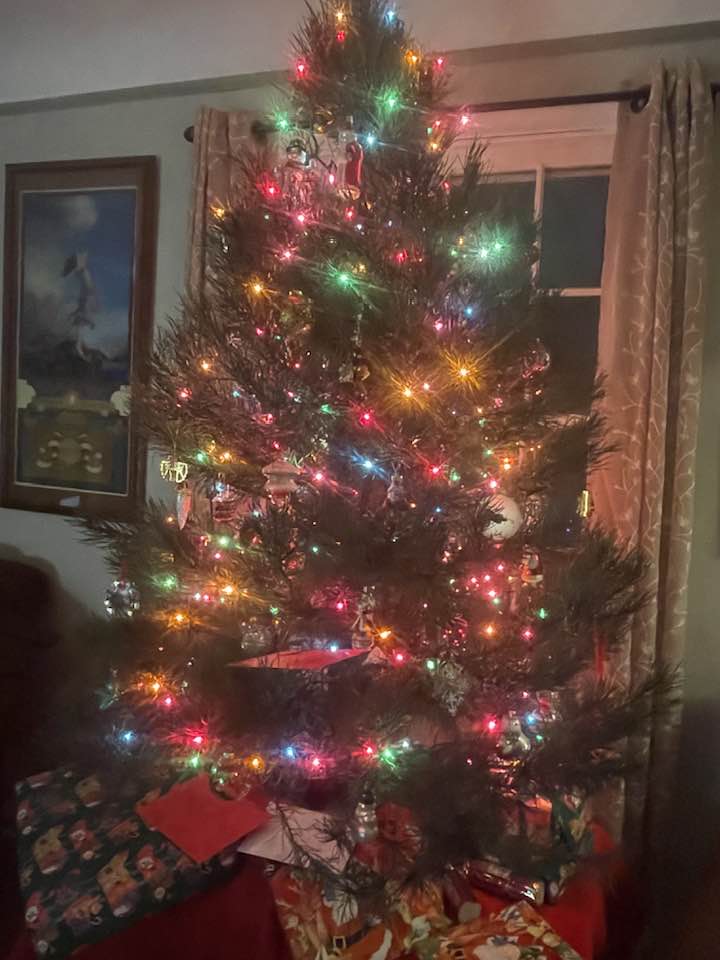
And in der heidnische Tannenbaum that my good and precious wife—who, in the name of that tree, nearly met an awful, untimely and ever tragic demise—decorated so masterfully, I find a timeless tradition that transcends our differences; the essence of what binds humanity to itself, one person to another, one generation to all the rest throughout the millennia, past and future.
Subscribe to this blog and receive notifications of new posts by email.
© 2025 by Eric Nilsson
[1] Our memories of him in that role make it ever more difficult to understand how and why he went off the rails . . . when he was about my age . . . becoming irascible, incorrigible, and impossible. Doubtless some part physiological and some part psychological, his mental state the last 20 years of his life rendered him the most difficult person with whom I’d ever had to grapple. By recalling his Christmas visits, however, and his largess of spirit in keeping with the season, I’m reminded that he had a hugely positive effect on our lives, despite what was most likely a combination of mental illness and extreme personality disorder.
