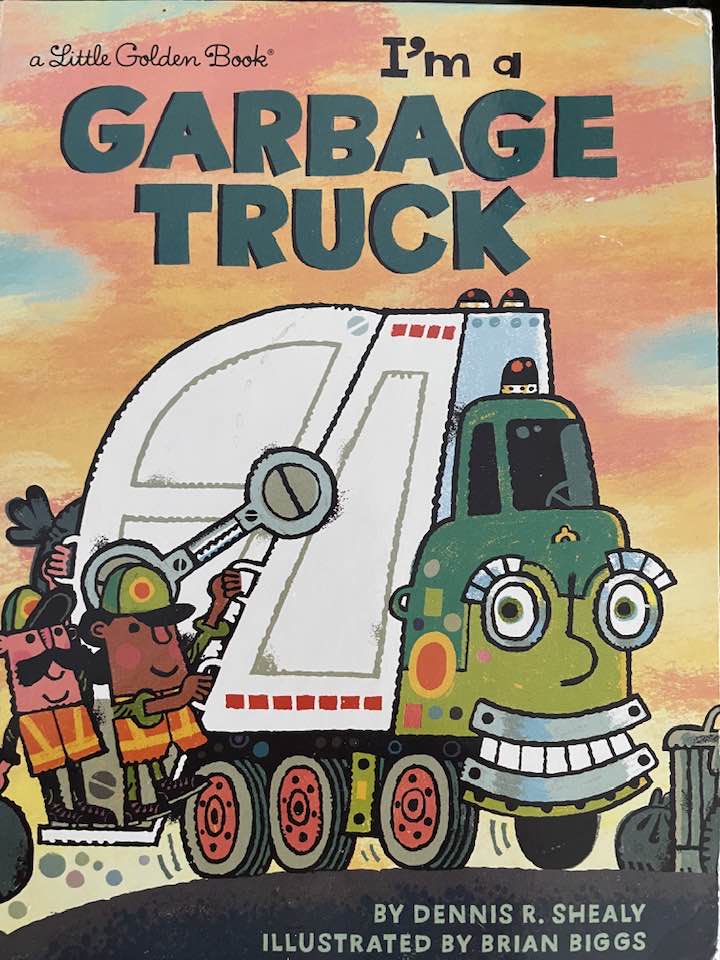
FEBRUARY 22, 2026 – (Cont.) Naturally, Dio likes us to read I’m a Garbage Truck out loud to him. But here’s the rub and the DEI feature, which, if you’re a Republican and even if you’re a Democrat, you might well think I’m taking DEI way, way beyond any reasonable dimension. But note in advance that I might well be having a little fun with my own “extreme, radical, leftwing, communist, Democratic [. . . Have I omitted any other adjectives that Republican propagandists deploy to shove everyone who’s not a Trumper across the centerline and into leftyville?]” politics.)
On the cover is the Garbage Truck, of course, with a full complement of facial features, plus two workmen standing on the back platform of the vehicle. These same characters appear together throughout the book, along with lots of customers who seem to have forgotten that “today” is “trash day” and in a panic are dragging full trash bags out the door in time for the pick-up crew. What I noticed is that the two crew members on the back of trash truck are definitely men . . . and men of color. Most of the customers are . . . you guessed it—white.
Now, if you analyze all this as much as I have, you can twist yourself into a lot of inconvenient knots. Let’s start with the age old notion that trash-haulers are at the very bottom of the unskilled labor chain. This impression follows from the indisputable fact that trash is at the bottom of our consumption chain, and except for recycled materials, pure trash is, well, just the opposite of pure. It stinks, it’s not pretty to look at, it’s often hard to contain. Somehow we have to dispose of it, and to do that, society must hire people to do what the rest of us have absolutely no interest in doing, though my grandfather, the Ivy League School Graduate (UPenn – Wharton School) and captain of industry, upon reaching a certain advanced age was known to pull stuff out of other people’s trash cans, because he knew that someday he could put their trash to productive use and save a dime or a dollar (known as “expense control” back at Wharton). But we won’t go any further with that right now.
My own prejudice against refuse haulers was formed at an early age, when I observed the Peterson Bros. trash trucks (two or three, as I recall) work their routes in my hometown of Anoka, Minnesota. The brothers (fellow Swedes, as my dad pointed out) were making a fortune (again, said my dad), but as far as I could discern the lackeys hanging on tenaciously as the tail end of the garbage truck bounced up and down were the consummate low-lifes, especially during the summer. They wore dirty sleeveless T-shirts, soiled blue jeans and oversized gloves that were as filthy as the trash they thrust into the compactor bin in the back of the truck. Their hair was all tussled, and I remember being totally grossed out when one day I watched one of the guys pull on a bunch of terribly rotten something or other that was stuck in a refuse can, throw it into the compactor, set the dented trash can back down on a driveway apron with a bang and then wiped his unbelievably dirty gloved hand through his unruly hair! What person, I thought, who’d gotten past kindergarten at Franklin Elementary School and knew the first thing about Sherm the Germ (see Friday’s post) would do such a thing? From that day on, refuse workers, I figured, were at the bottom of society’s pecking order.
But many years later, I watched a documentary about Denmark, which at the time, was considered the “happiest nation on earth.” The film featured all sorts of occupations in Denmark—including refuse removal—and the trash man, it turned out, was not just a person of garbage, but a community networker. He took an interest in all his customers and they in him, and on top of the fact he really enjoyed his daily work, he was paid an eminently fair wage. With that education, I had a new view of trash hauling, and as things would evolve in our own country, in some municipalities, garbage workers do quite fine financially, thank you very much, no doubt to union contract negotiators.
Where was I? Oh yeah—the back-of-the-truck workers in the Little Golden Book I’m a Garbage Truck. My kid-hood stereo-type of the garbage men in town collided with my “truth is the opposite of Trump” worldview. At first, in promotion of DEI, I thought, why should the two main characters, situated at the very bottom of socio-economic ladder, be depicted as men of color? Why not two white men. But then I thought about the documentary about the Danish trash hauler and a more enlightened perspective on what we’d have to categorize as “essential workers.” Why shouldn’t we be giving appropriate consideration for the demanding working conditions of refuse removal and heaping praise on those who at the right price would spend the majority of their waking hours hauling away other people’s garbage?
But that question conflicted with the über-DEI idea of putting two white men on the back of the Garbage Truck in I’m a Garbage Truck. If we turned the whole thing around and treated the trash-hauling vocation as one of esteem, then giving that role to the two men of color, was perfectly acceptable after all. On the other hand, why not make it two white women? Or one white woman and another person identifying as LGBQT? Or one man of color and a white woman?
I saw one big problem with my whole analysis: the generally perceived status of the two people standing on the platform at the back of the garbage truck, however successful my own transition from the view they were low-lifes to my currently far more enlightened perception. And then there was the question of technology. In our neck of urbanity, at least, trash trucks are completely mechanized. Every garbage-hauling vehicle is equipped with a giant hydraulic claw that reaches out, grabs the trash can and lifts it up and holds it upside down over the commodious box that sits on the truck chassis. The crushing compactor then does its thing as the trash can is restored to its resting place at the side of the alley, though often at a drunken angle. The whole operation is coldly mechanical, and the garbage truck itself does not lend itself to being depicted as some kind of friend of toddlers. Soon the trucks will be driverless, run entirely by AI.
Unable to resolve the matter, I put I’m a Garbage Truck aside and turned to another book in our grandson’s endless supply of books: another from the Little Golden Books collection, this one entitled, The Little Red Caboose, originally published in 1953. The story complements yet another Little Golden Book, The Little Engine that Could; instead of pulling the train up and over the mountain, as the Little Engine did, the Little Red Caboose helps push the train up and over (thanks to a double-locomotive that backs up the caboose). All the scenes along the route of the train are just peachy-fine (from the perspective of the apex of white prosperity), but around one curve as the Little Red Caboose approaches its ultimate challenge, suddenly appears . . . as the grandparent turns the page . . . a large idealized encampment of Native Americans of the Plains in the stereotypical parade costumes created by a white illustrator—from “back East,” no doubt.
The book wouldn’t meet today’s DEI standards . . . except, there are no DEI standards anymore. They all got . . . trashed . . . by Trump and hauled to the dump. Well, then, as I said at the outset, in the Trump Era, I look for “truth in opposites.” Therefore, what Trump sends to the dump is the opposite of garbage. If he were alive today, even my Republican grandfather would have to agree with that!
Subscribe to this blog and receive notifications of new posts by email.
© 2026 by Eric Nilsson
