FEBRUARY 21, 2026 – A hallmark of the Trump Era is the easy detection of truth in opposites. If Trump hates something such as wind power, for example, then I know I wind turbines are absolutely a good thing, no questions asked. If Trump’s Treasury Secretary Bessent tries to rationalize tariffs as a blunt instrument of some cockamamy economic and foreign policy, then I know for certain that tariffs are unquestionably a bad idea. If a candidate for elective office is a Trumper, then without consideration of any other factors, I know to support the candidate’s opponent. When Trump’s white supremist in the White House, Stephen Miller, or Trump’s DHS Secretary Noem call a person shot and killed by ICE agents a “domestic terrorist,” I know the murder victim was anything but a “terrorist.” And so on and so forth, going back (in Trump II, anyway), to “waste, fraud, and abuse,” which anyone with a sniffer could tell in advance would be the exact opposite: a vehicle for one powerful individual to commit . . . “waste, fraud and abuse,” not to mention a mountain of collateral damage.
Among the inexhaustible list of examples of “truth in opposites” is DEI—short for “Diversity Equity and Inclusion.” To be clear, I’ve always thought that DEI was a superficial and largely ineffective way to address generations of institutionalized inequities in society. Yes, it’s fine to acknowledge all that we got wrong, but when push comes to shove comes to DEI, what do we really have to show for it in the way of fundamental improvement in the chess board of life, rigged as it has been against so many people?
But then again, since Trump II condemned DEI and ripped all evidence of it from the public landscape I’ve become an undiscerning advocate of DEI, despite all its shortcomings and superficialities.
Before anyone can criticize me out loud for my knee-jerk opposite and equal reaction to everything Trump, I’ll readily acknowledge that my reaction “to everything Trump” is a sweeping generality. But that is exactly my point. I could paint other characters on the stage of history with the same broad brush. Anyone with a basic high school level of 20th century world history can name at least three names of who’s in the rogues’ gallery.
In the case of DEI, I do more than talk about it on this blog site. When our fourth-grade granddaughter mentions perfectly robust DEI “happenings” at school (hallway posters, mention of DEI inside the classrooms), I express my unabashed support of the initiative. I like to think that her school is flying completely under the roving radar of “big government” on this one, and unafraid about it too.
Then when I get notice of an upcoming board election for our rather sizable health care conglomerate, or any other entity whose shares we own, I don’t just toss the notice into the recycling bin. I go online, review the bios of the candidates and pull the lever, as it were, for the DEI candidates—provided, of course, that they’re qualified on paper, at least, and in every instance, that appears to be the case. I explain all this to our fourth-grade granddaughter, by the way, including the what and the why. My hope is that by the time she enters adulthood, the landscape in our society will be a more accommodating place for women and people of color. After all, she herself is half Asian in a culture and economy dominated all too long by white people.
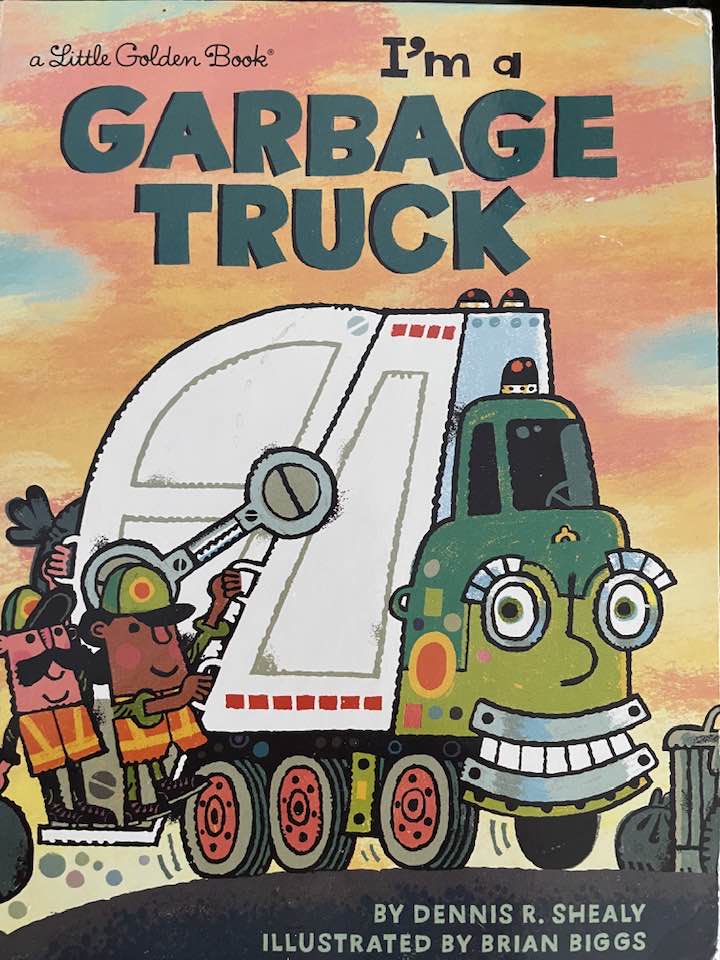
But then there’s our grandson’s Little Golden Book, I’m a Garbage Truck. He too—our grandson, not the garbage truck—is half Asian. I’m not sure what to do with the book from a DEI perspective. Allow me to explain.
By way of background, just as many of his peers, Dio is infatuated with heavy equipment—both the toy version and the real thing. As far as he’s concerned, garbage trucks and excavators are in a constant battle for first place, but close behind are hefty gas delivery trucks that occasionally visit his neighborhood. Just today while we all were out for a stroll, two propane trucks—different vendors—rolled by the narrow, winding street of our route. In each case, I gestured as I had as a young kid while waiting for the traffic light to halt traffic across Main Street in front of Franklin School. My friends and I would raise our fists in the air and bring them straight down a foot or so twice in quick succession to signal we wanted the driver of a semi to pull the cord on his horn. Usually, the drivers happily complied. Today, each of the high-perched drivers gave Dio a “HONK-HONK!” to everyone’s delight and for extra credit waved at us before we waved at them.
But “I digress,” as it is said. (Cont.)
Subscribe to this blog and receive notifications of new posts by email.
© 2026 by Eric Nilsson
