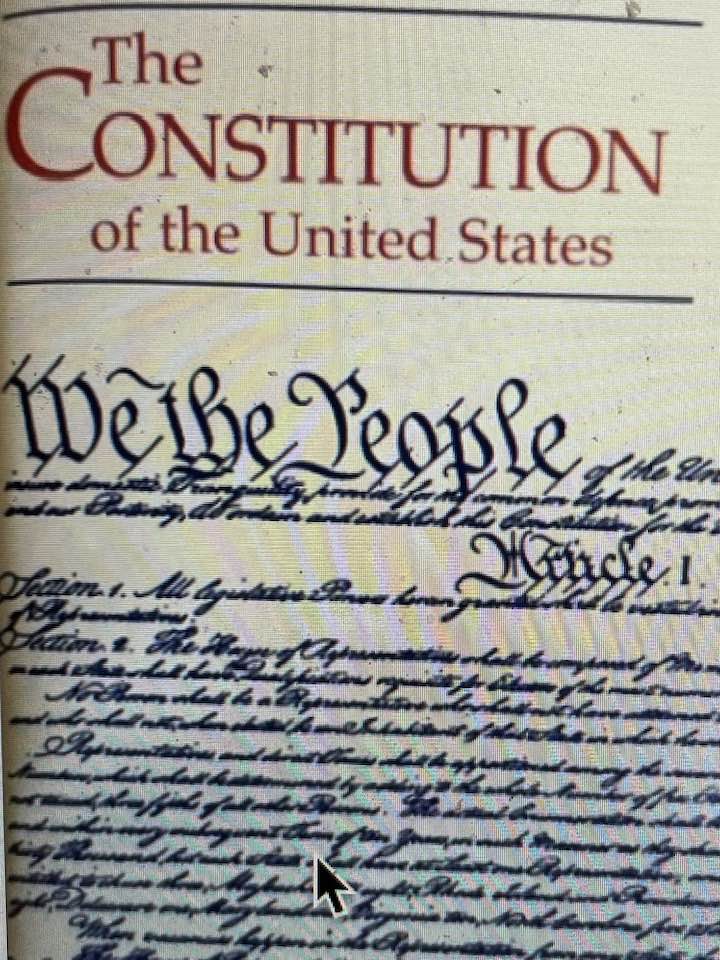
FEBRUARY 12, 2026 – This year is my “reporting year” for continuing legal education credits—a mandatory 45 hours’ worth for the three years ending June 30. Credits can be obtained from a variety of sources—Minnesota CLE, local law libraries local law school libraries, and a plethora of national sponsors. Aside from mandatory credits in the areas of ethics (2), elimination of bias (1) and mental health (1), 41 credits can be in a wide variety of practice specialties and subspecialties. I usually concentrate in my primary practice areas—secured lending, commercial real estate, and business law.
This time around, however, I’m impressed by the number of offerings in matters of constitutional law—or “con law,” as it’s often called by students. These courses have been developed largely in response to the Trump Administration’s relentless drive in authoritarian rule and attack on the rule of law. Just today I sat through an excellent seminar entitled, Constitutional Crisis of the Trump Presidency. Yesterday I attended a pragmatic webinar involving constitutional law: The Rights of Protesters and Legal Challenges to Protect those Rights. My next 21 hours of credits will comprise The Rule of Law; Constitutional Rights of Lawyers and Law Firms; The Age of Trump: Projecting Policy and Legal Impacts of a Second Term; and Navigating Polarization: The Role of the First Amendment—all in addition to my usual banking, real estate, and business CLEs.
Outside of law school, I’d never developed a particular interest in studying constitutional law. Occasionally a constitutional concept (e.g. the role of due process in a condemnation action or mortgage foreclosure proceeding; waiver (in a loan document) of the right to a trial by jury in the event of litigation) would appear in my law practice, but never to a level requiring me to “go to school” in constitutional law. With Trump’s second inaugural 13 months, ago, however, the constitutional law bells started ringing, and they’ve been pealing ever since, with increased urgency almost by the day. Both as a lawyer and a citizen, I felt a commensurate need—call it duty—to educate myself better about the full extent to which the current Regime has upended nearly 250 years of respect for the U.S. Constitution as the “Supreme Law of the Land.”
Ultimately, the Constitution is a set of intangible principles reduced to mere words on a page. The strength and power of the “words on a page” share the tenuous qualities of fiat money: neither the “presidents” or “Franklins” in the wallets of yore or the digits on an investment account statement have any intrinsic value. The value of “money” is based solely on a network of “trust arrangements” among us and the rest of the world. When I sell you my box of homemade cookies for 10 bucks, I accept your $10-bill because I trust that I can turn right around and use it to buy $10 worth of groceries at the store. If and when that trust evaporates, so does the worth of the $10-bill. Likewise, the Constitution. If the people and institutions subject to its jurisdiction no longer “trust” it and no longer agree to honor it, then will crumble our entire current structure of government and the rules by which our public and private affairs operate. Without a seamless transition to an alternative form of democracy (e.g. parliamentary system), we’d find ourselves living in anarchy or under a strong-fisted dictatorship.
Today’s presentation, by Professor Michael Stokes Paulsen of the University of St. Thomas School of Law, was deeply sobering. He reduced an entire semester course into an hour, and my attention was as focused as the presentation was concentrated. By the conclusion, I had heightened respect for the Constitution but also fears that in the span of less than two years, it has taken some severe blows and as a result, requires emergency attention.
Perhaps the most significant hit was the six-three decision in Donald J. Trump v. The United States, in which the Supreme Court held that the president has presumptive immunity for “official acts,” and motive can’t be considered in determining if an act is official. This decision fundamentally altered the “checks and balances” precept of co-equal branches of government, giving the executive exceptionally disproportionate power vis-à-vis the legislative and the judicial.
The Constitution took another big hit in the decision in Donald J. Trump v. Anderson, the Colorado case in which the state claimed that under Section 3 of the 14th Amendment, Trump was disqualified from serving as president because he’d “engaged in insurrection or rebellion against the [United States]” by way of his support of the January 6 insurrectionists and had thus violated his oath to support the Constitution.
In myriad other cases, of course, Trump has defied the courts with limited consequences. He perceives that nothing can stop him, and in fact, nothing has. Emboldened when the courts rule in his favor and defiant when they don’t, Trump has continually consolidated his power. The Republicans in Congress, meanwhile, have yielded their power to the president. They converted their co-equal branch of government into a rubber stamp of the executive.
To hear Attorney General Pam Bondi refer to Trump as “the greatest president this country has ever had” is proof positive that she needs remedial education in the area of constitutional law. She could start with Professor Paulsen’s webinar, Constitutional Crisis of the Trump Presidency, and progress from there. Perhaps Representative Jamie Raskin—an actual constitutional law professor—ought to hold remedial seminars for a whole lot of Congressional Republicans, as well.
Subscribe to this blog and receive notifications of new posts by email.
© 2026 by Eric Nilsson
