SEPTEMBER 5, 2025 – One common phenomenon among us “older folks” is being continually awestruck by the sheer volume of knowledge that lies beyond our capacity to encounter, let alone absorb. This sounds naively quaint. It’s the same order of naiveté as entering the Library of Congress and saying (out loud), “Geez Louise but this place sure has a heck of a lot of books! How would I ever have time to read them all?” Any halfway literate person within earshot of your tour group would likely think, Hmmm. What shack without indoor plumbing and no mail service does that person inhabit?
Despite the naiveté inherent in my epiphanous reaction to knowledge, the fact remains that I’m awestruck by what I don’t know and lack the capacity ever to know even a measurable sliver of what I don’t know. At first, entanglement with this thought seems as ludicrous as grappling with the notion of infinity, but when viewing it from a proper distance, this chronic condition—the lack of capacity—produces frightening insight into how ill-equipped our system of governance has become. Moreover, what’s abundantly clear is that the current regime of ineptitude, a manifestation of our structural deficiency—system of government—is shoving our country backward.
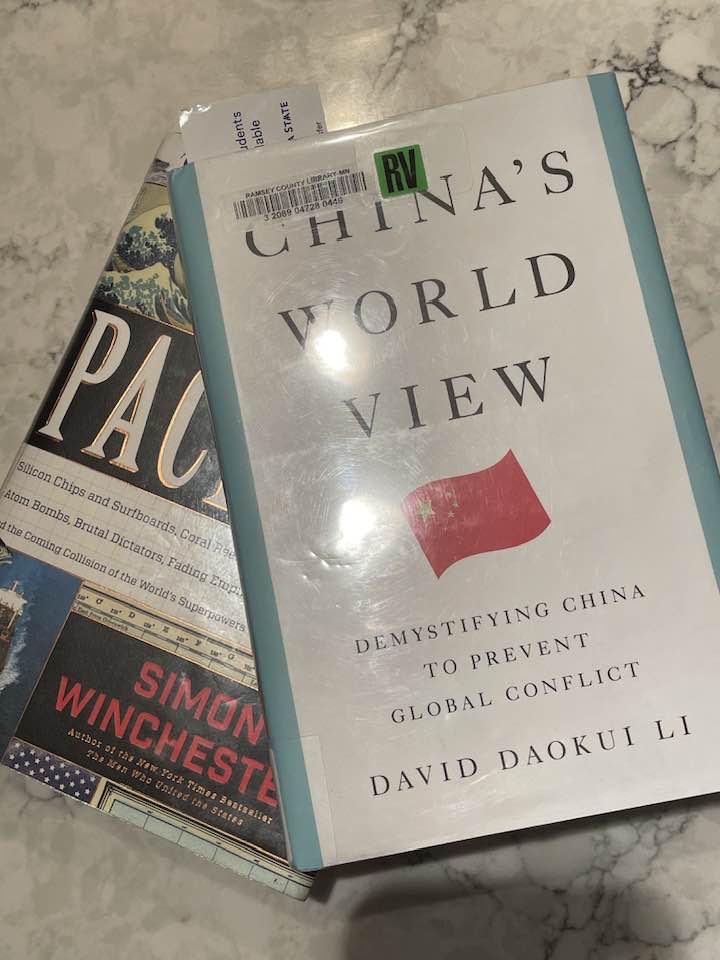
Currently I’m reading two books that overlap to produce explosive revelations. One of the books is Pacific by Simon Winchester, which I’ve already mentioned in a recent post. The second book is China’s World View: Demystifying China to Prevent Global Conflic, by Dr. David Daokui Li. With his journalistic background, Winchester applies a disciplined approach to his subject matter(s). His research and investigative methods are credible. His story-telling skill and writing style render his work eminently accessible. David Li was wholly unknown to me and is likely unheard of by most members of Congress, not to mention members of the Trump Sycophancy. The man is an academic, an economist, an observant member of the elite within the Chinese economic and political realms. One must assume that he enjoys approval among the high and powerful within the Chinese hierarchy of governance. As an insider, he provides insights—expressed in flawless English—at once biased, yet surprisingly candid, and in any event, hugely informative.
Winchester’s book includes a mind-boggling survey of how China has expanded its naval presence in the western and southern Pacific, and taken advantage of America’s abandonment of military bases in the Phillipines following the eruption of Mt. Pinatubo in 1991. Dr. Li’s book delves into economic and political conditions in the PRC. I’m now far more aware of our own nation’s relative weakness and loss of advantage and realize the folly in equating ignorance with bliss. It’s a bit analogous to UV rays, viruses and carbon isotopes generated by the burning of fossil fuels. We can acknowledge them or deny their existence, but in either case, they’re real and produce real effects.
In digesting the newfound (to me) knowledge of modern China and its strategic designs, I can’t help but conclude that thanks to what we’ve become, what we’ve done to ourselves, China is in the process of eating our lunch. Joining it at the table, albeit in a firmly subordinated seating arrangement, will be Russia, Iran, North Korea, and late to the party, opportunistic India.
In all honesty, however, had I not by chance happened to read these two books, I would’ve continued in my usual blissful ignorance of all that goes on in the world that one way or another will have a profound effect on my life—and yours. Which takes me back to my observation about capacity for knowledge—a case of limited finite storage space and processing power vs. an infinite amount of data. But forget me. Relatively few people are dependent upon or affected by my decision-making and therefore, minimally vested in my capacity for knowledge and ability to synthesize it. The people we all should worry about are our elected officials in Washington. What is their individual capacity and ability?
For starters, under our system, they expend enormous capital—time and effort—on raising capital to get re-elected[1]. Then there are the multifarious needs and requests of constituents; participation in party strategizing; keeping track of bills, committee hearing schedules, and caucus meetings—all before even touching complex policy matters from A through ZZ for which their constitutional role (actual law-making) is designed. Of course each member of the House and Senate has a staff, briefing reports, even scripts to aid in all these activities, but ultimately, each member has a vote on every bill and resolution. Collectively, they wield tremendous power . . . well, used to, anyway.
But as I confront my own fathomless ignorance, how, I wonder, can anyone in House or Senate, no matter how gifted and efficient intellectually, no matter how sincere in intent . . . how can they deal with the foundational problem of limited capacity—starting and ending with the ultimate universal and immutable stricture: time. On the heels of this reality, I worry that while the very best of our legislators are constantly torn, stretched, pressed, and distracted in 100 different directions, and while the most ill-equipped president since April 30, 1789 (the day of Washington’s first inauguration), plays retributive tariff terrorism, engages in dictator worship, hires advisors based on “how good they look on TV” and fires them if they deliver news that “makes him look bad on TV,” few well-informed, “high capacity” people in high-level elective positions have their eyes glued on China. Meanwhile, the federal bureaucracy, which for generations housed legions of experts who did know what was going on in the world, has been eviscerated under the guise of eliminating “waste, fraud, and abuse”—code for “red meat for MAGA,” given the anti-knowledge, anti-science, anti-expert tsunami that has washed over masses of the electorate, who not only lack the capacity for expanded knowledge but lack even the capacity to know that.
As Dr. Li explains in China’s World View, in theory, and to a very real and very large extent in practice, China is run quite differently from the U.S. For an entire generation, well-informed academics, scientists, economists, strategists, as well as “people on the ground” with practical knowledge and perspective—in other words, experts of all stripes—have participated heavily in policy formulation in China. Sure, most or many are card-carrying members of the Communist Party, but input that is solicited and elicited isn’t expected, or in a number of respects, allowed to be, dogmatic, doctrinaire, or sycophantic. Is the system flawed? Of course it is, but if I were a political food critic, I’d readily conclude that China has positioned itself well to eat our lunch.
Subscribe to this blog and receive notifications of new posts by email.
© 2025 by Eric Nilsson
[1] I remember Missouri Senator Thomas Eagleton in his keynote address at the plenary session of the 1991 Mondale Forum at the Hubert Humphrey Institute (University of Minnesota) blasting the overwhelming role of money in politics. He said the reason he finally decided to drop out of the Senate (1990!) was because he was absolutely exhausted having to devote so much time throughout each term—not just ahead of campaign season—raising money for the next election. Little has changed in this regard over the past 35 years. (I was a fellow in the program—along with Amy Klobuchar, at the time an attorney in the office of the Hennepin County Attorney, who went on to bigger and better things, such as the United States Senate and a run at the Democratic nomination for president in 2016.)
