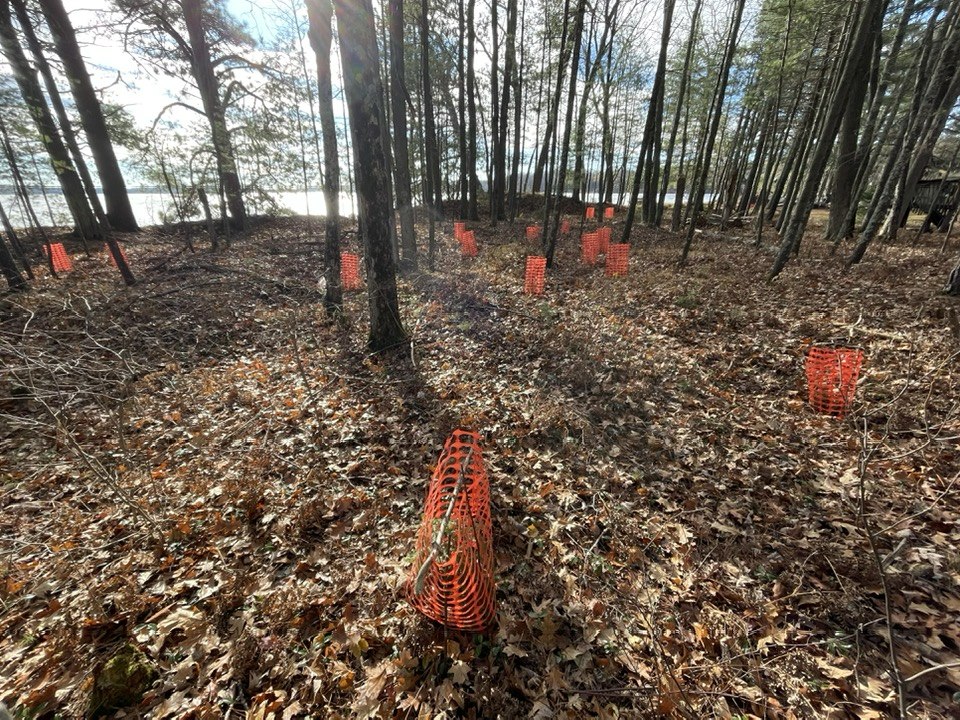
NOVEMBER 15, 2025 – As the rest of the world turned in earnest, I worked (earnestly) in my own little corner of it, continuing the annual fall project I started yesterday: installing protective fences around hemlock saplings and stapling paper “bud caps” on the terminal shoots of the young white pine, all in the woods of Björnholm. By day’s end I had much to show for my efforts—not against the measure of what turns the earth, necessarily, but by the gauge of my modest expectations.
What’s most notable about the work and what brought me “heel-kicking” delight, was the discovery that the total planted hemlock inventory is 49, not 30. I’d lost track of 19 of the trees, 15 of which appeared as if by magic in the woods immediately east of the Red Cabin. They’re now brightly conspicuous given the bright orange fences I fabricated[1] and installed today.
As I assembled the fences, the susurration among the surrounding trees reminded me of the sea, of waves cresting after their long journey from beyond the horizon, then washing over a rocky shore. And tying the orange fences together with twine, I imagined I was the fisherman repairing his nets. Simultaneously with a gust that rushed through the towering pines, I heard a late-migrating loon issue a distress call, like the long wail of a seagull carried by the wind.
This afternoon I resumed yesterday’s bud-capping operation until I ran out of pre-cut paper. With a replenished supply and only 130 trees to go to reach a target quota of 300, I’ll complete the project by early afternoon, whereupon I can begin another annual tree garden project: pruning the white pine saplings up to a third of their height.
The scale of the white pine work—bud-capping and pruning—is well beyond my capacity and even that of multiple assistants, assuming I had them. The “tree garden” has thousands of white pine seedlings and saplings, and it’s unrealistic to think that all can be protected from browsing deer. In fact, my efforts and objective could be questioned. Why not let nature follow its course? After all, millions of white pine trees have survived the deer. Yet, whenever I read about white pine cultivation, two recommendations are always front and center: bud-capping and keeping an eye out for signs of blister rust and trimming affected branches. More to the point, however, I’ve seen what deer can do to uncapped young white pine. The “forest cows” are often random in their choices, and there’s no way of discerning in advance which trees are more vulnerable. I’ve seen lots of uncapped white pine seedlings and saplings lining an established deer path go undisturbed, yet a young lone unprotected white pine some distance from a deer trail will be some deer’s snack.
The hemlock, meanwhile, are a delicacy to the cervine palate, and as I mentioned in yesterday’s post, the most important hemlock of them all—the “wedding tree”—was nearly eaten alive the year I’d neglected to build an adequate barrier against the deer.
Thus, as long as I’m able and inclined, why not do what I can to aid the trees, which are such a critical part of our ecosystem?
For the most part today, my nose was to the grindstone (“Grindstone” perhaps, since all of this took place near the shore of Grindstone Lake). But much of the work required a knee to the ground, soft with fallen leaves. All day the sun streamed through the woods, and angled as it is at this time of year, it worked as a spotlight on all it struck. With all deciduous foliage down, every fold and nuance in the topography is now visible, as are the moss, lichen, nooks, crannies, hollows and hideouts across the woodland floor and among the trees—standing and fallen. The possibilities for troll, elf and fairy dwellings are infinite, and so are the chances of sightings of those inhabitants, though none materialized today.
What did appear, however, was the most memorable sight—billions of diamonds racing across the surface of the lake, blown by the wind as if they were weightless. I marveled at this effect, the result of a perfect collaboration of sun angle, wind direction and velocity, and rippled water. The dazzling water gems seemed to reflect the billions of stars in the galaxy, unseeable in the light of a single star—our sun! While I was mesmerized by it, I was the wealthiest man alive, richer by far than Musk, Bezos, and Zuckerberg combined.
As the North Pole tilts away from the sun, the ebbing daylight curtailed my work. I watched the sunset from the pergola, and with the leaves down, I was afforded a magnificent view of the lake and silhouetted shoreline. In the twilight I followed the path back to the cabin, stopping frequently to admire the silhouetted trees as they swayed gracefully in the breeze. One grove of especially tall Norways reminded me of a group of tenors singing in multi-part harmony above the rest of the woods. I imagined sitting atop their crowns, moving a good six feet this way and that in perfect synch with the music.
By the time I reached the cabin, the stars were out. I had plenty to choose from on which to make a wish—and contemplate my gratitude for the beauty of this world.
Subscribe to this blog and receive notifications of new posts by email.
© 2025 by Eric Nilsson
[1] With a bit of experimentation I developed an efficient assembly line method of making these out of recycled orange plastic temporary fencing often used on construction sites and available by the roll foot-feet wide. After deploying some basic geometry, I settled on two sizes, cut the large sections I had down to these two versions and tied the ends together in three places, using ordinary twine. To stake each fence, I used two sharply angled hazel bush stems.
