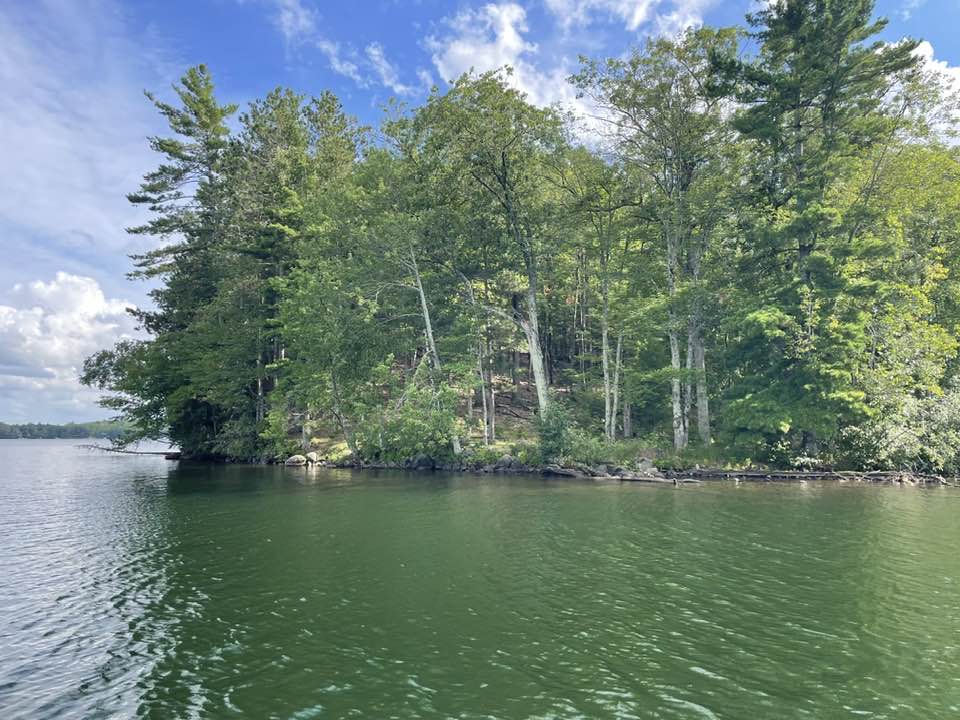
AUGUST 10, 2025 – Today our crew—Cory and family, Byron and family, Beth and I—took an extended lake cruise aboard Northern Comfort. After steaming the long diagonal from home port to the channel into Little Grindstone, thence west-southwest along what I call the “Barbary Coast,” I changed course toward the islands in the southwest. Very carefully, I navigated behind Big Island, then slipped through the narrows that separate the north end of the island and the mainland. As we motored slowly past the island, Beth called our attention to the infamous campsite where we’d spent the night in one of the worst storms we’d ever experienced in our years at Grindstone Lake.
It was the last time that Beth and I ever went camping. Toward the end of a beautiful Sunday afternoon, our sons—12 and 9 at the time—lobbied Beth and me in earnest to take them camping on Big Island overnight. Beth wanted to accommodate them, but I was less enthusiastic. I’d planned to take the next day off work, so we weren’t leaving for home until the next day, in any event, but as I stood on the dock and viewed the sky, I noticed a high level cloud deck moving in from the west, a tell-tale sign of a change in weather likely laden with precipitation.
At the time, our closest thing to communications technology at the cabin was a land line phone. Beth’s parents were more technologically advanced than we: they had a television. At around 6:00 p.m. on that fateful evening, she called her dad to see if he’d heard any evening weather forecast. He had. “Mostly clear,” he said, not realizing that what he’d heard was the forecast for Milwaukee, a million miles away. When Beth conveyed this information to me, I was skeptical, but I didn’t openly question it or offer meaningful resistance to the momentum that now took effect.
Soon Beth was directing operations. We’d have an easy dinner of hot dogs followed by roasted marshmallows over a campfire and a breakfast of eggs and toast, so as she organized food, condiments, roasting sticks, paper plates and paper towels, she told me to round up the tent, sleeping bags, a lantern, bug spray and a deck of playing cards to entertain ourselves between nightfall and bedtime. Since it was supposed to be “mostly clear,” we didn’t much worry about rain gear. But then again, as things turned out, no amount of rain gear would have been adequate. After pulling all our stuff together, I readied the Alumacraft and loaded it up. By about 7:00 we were off, two grown-ups and two kids, bound for an adventure that none of us saw coming.
All went smoothly initially. We set up the tent, unrolled our sleeping bags inside, then got a nice campfire going. In no time, we were roasting the top layer of a package of Oscar Meyer all beef wieners. In the absence of a salad, I remember, I applied extra quantities of condiments. I had plenty of room for marshmallows afterward, as did everyone else.
As dusk yielded to twilight, we fed our napkins and paper plates to the fire. At about this time a wind came up. I knew this was a bad sign. In the first place, during stable weather daytime breezes tend to diminish at day’s end when the air temperature cools. Wind at night—especially when it increases, as it did on that occasion—often portends stormy weather. Second, the wind was out of the northeast. This was an even worse sign. I’d never seen the wind roar out of the northeast. Because our campsite was on the windward side of the island and the island was in the extreme southwest corner of the lake, this meant that the wind had about a four-mile stretch across open water before it slammed smack into our campsite. Already the waves were building ferociously.
Sure enough, behind the wind and waves lightning flashed in the distance, followed by rumbling thunder. We repaired to the inside of the tent. It was no Eddie Bauer deluxe model. Ever the bargain hunter, Beth had gotten it on sale at Target, and we would soon learn the difference between a deluxe tent and a discount model.
Inevitably, rain came. Before Beth could finish shuffling the cards, however, large raindrops turned into a veritable torrent, soon followed by a deluge. Wind gusts were accompanied by more frequent lightning and thunder with increasingly shorter intervals between light and sound. The walls of the tent began flapping back and forth, as if we were inside the lungs of some hyperventilating beast scared out of its wits. Beth and I were plenty scared ourselves and stuck to the card game to camouflage our fear. Not long after the wall-flapping started, water seeped through the ceiling and walls of the discount tent. Soon it was as good as raining inside our flimsy shelter.
By now there was hardly any time between lightning and thunder and no abatement of ferocity in the wind-driven rain. I began to worry. What if a lightning bolt hit the tall Norway pine 12 feet from our tent? I’d seen on our land what lightning had done to mature pine trees, and it was nothing short of explosive. What if the tree was struck and severed from its base? What if it fell on our tent? We’d be crushed! I remember having seen sizable rocks near the tree. As crazy as it now sounds, I decided that as a precaution I should pile the rocks up near the base of the tree so that if it fell in the direction of our tent, the rocks would keep the log high enough off the ground so as not to smash us—as long as we were lying down. Yet, to reveal how fear can work on one’s imagination, after I’d executed this cockamamie plan and returned—utterly drenched—to the tent, it occurred to me that maybe my plan wasn’t so smart after all. What if lightning struck the tree, ran down its trunk and . . . with supernatural power blew the rocks to smithereens, sending gneiss and granite shrapnel out in all directions, including through our thin nylon tent walls and into us?! I scrambled back outside and demolished my “pile of potential shrapnel.”
At one point I said to Beth—or rather, yelled to her to be heard over the storm—“If we were back at the cabin right now, we’d be saying, ‘Gee, good thing we didn’t go camping on the island!’ except . . . we did and here we are!”
I don’t remember that any of us got a wink of sleep that night as the storm raged on without letup. An occupied dwelling was less than 150 feet away across the narrows from the island, yet it may just as well have been a mile away. Under the conditions there was simply no reasonable way to cross to safety.
Meanwhile, I kept counting the seconds between lightning and thunder. The whole night long I never got past “one thousand three.”
Somehow the fates allowed us to survive the horrific storm. Just before daybreak the CRASH-BOOM of the lightning and thunder ended and the wind died down. Just after daybreak the rain finished, as well. We decided to be done with camping and get ourselves back to the cabin as fast as we could. First, though, I had to bail out the boat. So much rain had fallen that the lake level had risen over the transom of the Alumacraft, which I’d dragged onto shore after we’d landed the previous evening.
We didn’t bother folding or rolling up the tent or the sleeping bags. We just stuffed it all wholesale into the boat, shoved off and headed straight back to the Red Cabin. There we dragged all our sodden gear up into the yard and spread it out to dry. Or so we’d intended. Not more than five minutes after we’d struggled to set everything out to dry, the rains returned. Exhausted from fear and lack of sleep, we decided to leave everything just where it was and head to our (dry) beds to catch some shut-eye until conditions improved, which they did later that day.
As I noted above, it was the last time Beth and I would go camping–anywhere[1]. As far as we were concerned, the maxim that best applied to our circumstances was, “Quit while you’re ahead.”
Subscribe to this blog and receive notifications of new posts by email.
© 2025 by Eric Nilsson
[1] Not so in Byron’s case. Some years later he led several overnight camping expeditions to the same site on the north end of Big Island. They involved half a dozen school friends he’d invited up the to Red Cabin. From the dock and with the aid of binoculars, we could monitor how much trouble they were getting themselves into. Plus, by that time, everyone had a cell phone.
