OCTOBER 8, 2025 – Back in the day I used darts, not dice, to decide when to take the boat(s) out of the lake at the end of the season. Beginning in mid-September I’d simply keep my eye on the weekend weather forecast and a few days in advance of a Saturday or Sunday with likely cooperative conditions, I’d throw a figurative dart at the calendar to pin down tentatively the dock and boat removal weekend. If the weather went sideways, I’d have plenty more fall weekends for the “dart toss.” But that was when I did everything myself. It was hard work, but in contrast to how I made a living during the week, I rather enjoyed the engineering challenges of dock and boat take-out.
Eventually I got older. Moreover, we bought a pontoon but no trailer. Why no trailer? Let’s just say I was “done with boat trailers” and leave it at that. After decades of DYI, I now hire a marine store/operation in Hayward to pick up the boat at the public landing on the other side of the lake and haul the vessel away for engine winterizing and winter storage. In the spring, I arrange to have the boat delivered back to the landing, where I board and skipper the pontoon back to our place for the boating season.
All works well, except what used to be a game of darts is now a roll of the dice. Weeks in advance of your desired take-out date, you need get on the schedule. For obvious reasons, weekend slots are the first to fill up. The problem with this system is that it’s driven by availability, not weather, and this volatile parameter is what renders the operation a “roll of the dice”: unlike the good ol’ days, you’re at the mercy of someone else’s schedule, not your own.
This year, in early September I rolled October 5—last Sunday, late afternoon. As the date approached I began checking the forecast, and each time I did, predicted conditions deteriorated. By last Friday, things looked frightful—high winds with a chance of rain. The rain I could handle (absent lightning), but high winds were problematic for the plain reason that because the lake level had dropped so much, I anticipated difficulties floating the boat off the lift. No doubt I’d need to get in the water to wrangle the boat off the lift, and once I did, I’d need to push the bow around into the wind well clear of the lift and dock. Without hesitation, I’d then have to climb aboard and start the engine before wind and waves shoved boat and helmsman into the rocky shoreline.
The scenario that was shaping up—a bad roll of the dice—led me to re-schedule the “take-out” for today . . . a second roll of the dice. Fortunately, however, the predicted conditions were more accommodating—except . . . a hard frost was forecast overnight Tuesday/Wednesday. Our motor is extremely reliable, but it’s not a good “cold weather” engine. I began to worry: what if I couldn’t get the darned thing started? (On Saturday I’d succeeded in deploying an unusual technique to float the boat off the lift—see my 10/4 post.) Hmmm, I thought: a classic first world problem.
I needn’t have expended an ounce of “worry capital.” In the event, all worked out. At high noon I donned my swimming trunks and slid off the dock and into the lake. Where the water depth is normally near waist-deep it’s now between my knees and hips. With the improved leverage that I now enjoyed I was able to maneuver the boat off the lift with relative ease (as noted in my 10/4 post, I’d positioned the boat partially off the bunks before raising it out of the water). In the warmth of sun free of clouds, the (black—warmth absorbing) motor started up on the first crank of the ignition.
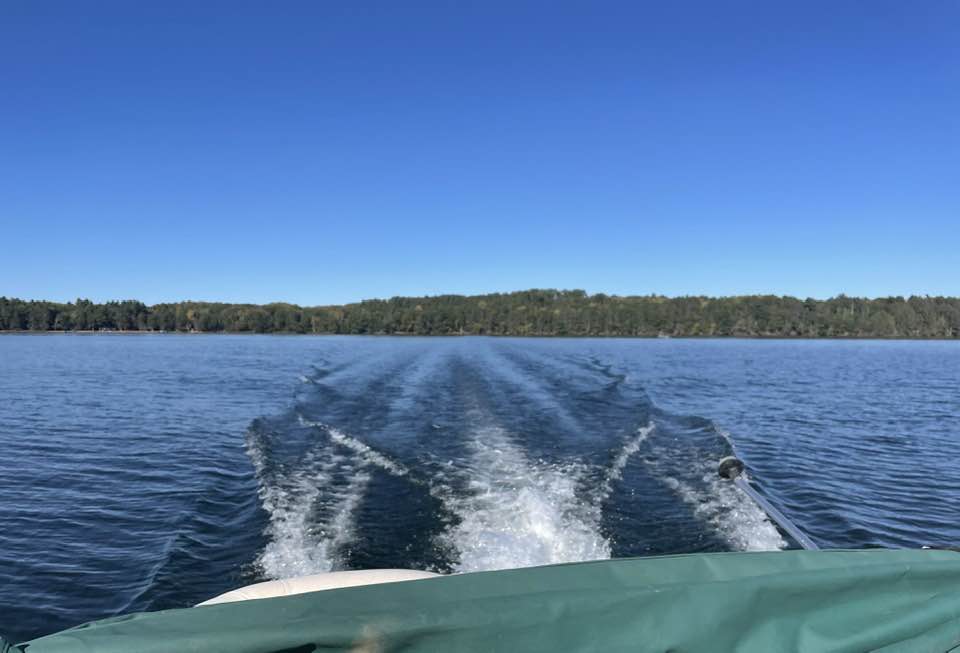
After coordinating by phone with folks at Hayward Marine, I backed out of home port for the last time this season. Once I’d cleared the lift by a few lengths, I shifted to neutral, tilted the motor down, then turned hard to starboard until the bow was pointed out to sea and proceeded ahead—slowly, keeping my eyes on the lakebed through the calm crystal-clear water. Once I’d achieved adequate depth, I opened the throttle and set a course for the boat landing two miles away.
There’s no freer feeling than to be at the helm of a boat—any size—rowing, sailing or motoring toward the sun, leaving all worldly cares in your wake. I encountered only two other watercraft on my passage. Both were stationary. The first was about 200 feet from my launch point and occupied by two geezer fishermen. I waved and they waved in return. The second boat was anchored 300 yards from my destination; no waving this time—the lone fisherman was busy baiting his lure, and I was focused on lining up with the buoys at the landing. But I did lower my speed to reduce the wake past the guy.
Northern Comfort was the sole vessel at the public landing, and without the pressure of anyone except Jeff Ramos of Hayward Marine on hand to grade my skills, I executed a perfect approach onto the awaiting trailer. “You landed it like a pro!” said Jeff, after I shut off the engine. But of course, a real pro isn’t told that they “landed it like a pro.” That’s fine. Given my growing catalog of dumb mistakes in the “Pergola-on-a-Platform” project, my self-esteem can use the added support. Whether powered by sails or an engine, I’ve always prided myself in landing a boat. Just don’t ask me if I’ve landed so much as an inner-tube where tide and surf were involved—or skippered anything over 22 feet, LOA.
On hand to cart me back to the Red Cabin was my good brother-in-law, Chuck Ullery, who’d graciously agreed to accommodate my roll of the dice. Without complaint or hesitation he agreed to drive miles farther than would’ve been necessary had I removed the Styrofoam water noodle from the pontoon before Jeff hauled it away. Five minutes after we’d departed the landing, Jeff called to inform me that the noodle had blown out of the boat and landed on the “right side of the road about a mile north of 27 and K.” A few minutes later as we drove south on 27 from Williams Road, Chuck and I spotted the renegade noodle. We circled back, and in character for the son of a U.S. Coast Guard Academy graduate, Chuck “stuck a perfect landing” along the shoulder. I jumped out and recovered the long skinny light green water worm. Keeping up with contemporary practice, I snapped a photo of the noodle and sent it via text to Jeff. The caption: “Rescued!”
And so concluded the 2025 cabin boating season.
Subscribe to this blog and receive notifications of new posts by email.
© 2025 by Eric Nilsson
