MARCH 6, 2026 – I read somewhere—I think it might’ve been in The Shallows: What the Internet Is Doing to Our Brains by Nicholas Carr—in which a study of London cabbies revealed overly developed memories in the region where navigational information is stored. Obviously, the study pre-dated Google Maps and other familiar GPS-based apps. Today while listening to a five-hour webinar entitled, Navigating Polarization: The Role of the First Amendment, sponsored by the University of St. Thomas School of Law, I wondered about those cabbie brains. The webinar was part of the school’s 2025 Spring Law Journal Symposium featuring a wide cast of academics—law professors, social scientists and political scientists. The individual and collective erudition of these folks was enough to stir awe and wonderment in the minds of the audience . . . or at least in my mind. How could so many people study and investigate a subject (and its infinite tangents) to such esoteric depths and develop such scholarly analyses? As I pondered their presentations, I wondered if the portion of their neocortices where philosophical hair-splitting is carried out (with real-life consequences, mind you) are as over-developed as the brains of those London cabbies of yore. I also tried to picture the professors beset with a balky lawnmower. But one never knows, any one of them might be an accomplished gearhead with a special skill at small engine repair developed as a hobby or on the job between their junior and senior years of high school.
When during a break I rose from my chair to look out the window at the wet colorless day, I felt a cold wave of depression break over the back yard and seep into the house, where the gray water swirled around my ankles. My knee was still quite sore—the result of a clumsy mishap yesterday afternoon, when I tripped on the steps leading from that very room and up into the living room. I’d been clutching the 27 pages of our state tax return—roughly half in each hand—a necessity of some glitch in a single schedule, the “KS,” that had prevented the return from being filed electronically. The bum knee is problematic. Think “stairs,” for one thing.
To distract myself from the knee, the dismal weather and the arcana wrapped in the esoteria of the webinar . . . before returning to the webinar . . . I checked quickly the latest news headlines. By God, Trump does have his sights on Cuba. I’d been joking earlier, but we live in an era marked by what makes sense today that never would’ve made sense in any previous era, except, it could be argued, during the presidency of John F. Kennedy: the invasion of Cuba. I mean, all the stars are lining up for Trump’s takeover of Cuba: STAR #1: Cuba hasn’t moved since the Great Flood; STAR #2: If you draw a line from New Orleans across the Golf of Trump to Caracas, it runs directly over Havana; STAR #3: No one—got that? No one, not even, it appears, Jeffrey Epstein from the grave—is going to stop Trump from doing whatever enters his chaotic mind to do.
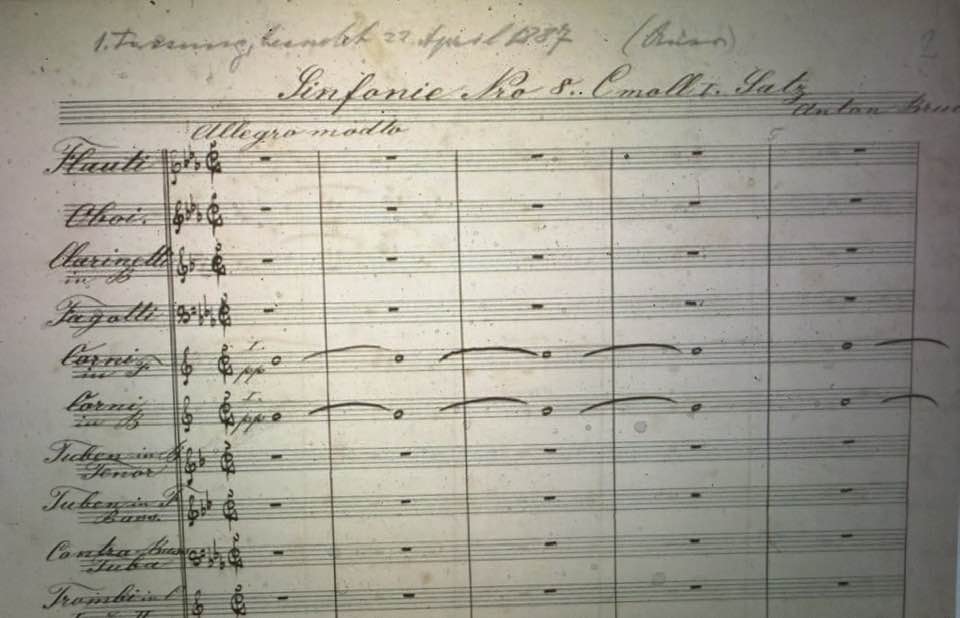
The world really is unraveling, I thought. Well not quite, the more I thought about it. This evening I’d be attending a performance of Anton Bruckner’s Symphony No. 8 by the Minnesota Orchestra under the direction of Thomas Søndergård. After Bruckner’s Seventh, which, with my sister Jenny, I heard the Vienna Philharmonic perform in Carnegie Hall last year, the Eighth is my favorite. For the hour and 22-minute-long symphony, I would be in some version of nirvana, all cares—from my knee to Cuba (let alone the Middle East) to the First Amendment—scattered into the ether high above Orchestra Hall.
Beth has never been much of a fan of classical music, and Bruckner isn’t for the uninitiated. When I learned that the Minnesota Orchestra would be performing the Eighth this season, I hadn’t burdened her with the necessity of turning down a ticket. Instead, a couple of months ago, I asked my sister Elsa and brother-in-law Chuck, both retired long-term members of the Saint Paul Chamber Orchestra, and frequent concert-goers if they’d be interested. Before I could say, “Bruckner Eight,” Chuck informed me that he’d bought us three premiere tickets.
When struggling with my cold earlier this week, I worried that I might have to bail from the concert. I would’ve been terribly disappointed. When skies cleared, as it were, yesterday, I gave myself permission to attend the concert.
The evening was as dreary as the day. When my ride appeared, my mood was as dismal as the fine rain that covered my eyeglasses as I exited the house. With catch-up conversation—we hadn’t connected in several weeks—the needle of my mood meter fluttered, then shifted into positive territory. We then talked about Bruckner. Elsa had played the Eighth under Stanisław Skrowaczeski, a Bruckner expert (and in the 1960s, conductor of the Minneapolis Symphony (renamed the Minnesota Orchestra in a marketing move to increase its “fan base”)).
A half hour later we were comfortably seated in our fancy seats on the main floor of the hall. From the downbeat onward, I was in another world.
Bruckner made his living as an organist and was quite well regarded in that capacity. When it came to composing, the critics considered him somewhat an amateur. The story was, he never quit revising his symphonies. Whatever the “experts” thought, in my opinion, his symphonies—especially Seven and Eight—are magnificent works of art. The voicing and sheer musical depth and breadth of these works draws in performers and audience alike to rarified levels. My big takeaway from this evening’s concert was the realization that only a great organist could come up with such compositions as Bruckner’s symphonies.
The orchestra produced in a noteworthy (pun full intended) rendition of Bruckner’s work. No member of the 80+ musician ensemble gets to sluff off. Most are going full tilt throughout the piece, and every wind and brass player has ample opportunity to screw up an entrance, However nervous the musicians might’ve been, as an audience member, I never worried. These pros were on top of their game.
The performance transported me light years away from my pre-concert doldrums. As I sat there enthralled by the music, I realized that Bruckner is not for insouciant participants. Whether on stage or in the audience, you have to throw yourself in completely; no tip-toeing around the pool deck; no wading in to test the water temp; no keeping to the shallow end of the pool three times the length of an Olympic pool. You have to dive in at the deep end and swim rigorously, end-to-end until the bell rings and you’ve expended every ounce of mental energy you possess.
Bruckner—especially live, in a great hall—isn’t for amateurs or people afraid to swim in water too deep to touch the bottom. The only way is to go all in. The musicians this evening were certainly “all in.” Judging by their unbridled applause, with great swells whenever a principal or whole section was singled out by the conductor, the overwhelming majority of the audience were very much “all in,” as well.
This transcendent musical experience gave me encouragement. Against the backdrop of chaos and dysfunctionality in the world, the sublime is alive and well—thanks to all the musicians of the world and their audiences.
Subscribe to this blog and receive notifications of new posts by email.
© 2026 by Eric Nilsson
