JULY 1, 2025 – Early Friday we bade farewell to the City and headed north . . . I mean east . . . I mean northeast . . . back to Yankeedom, to the “Constitution State.”[1] What I’ve realized quite recently is that the Connecticut shoreline along Long Island Sound doesn’t run on a strict east-west axis. It “slopes” southwest – northeast. What brought this to my attention was driving the mile or so on I95 between Route 9, the race track that runs from Hartford to Old Saybrook, which we catch outside the delightful village of Chester, where our son’s family resides on the west side of the Connecticut River, and Highway 156, the much tamer and classic New England road that twists and turns over the undulating terrain north to Lyme, where our family retreat overlooks Upper Hamburg Cove. What I noticed as a driver but had ignored as a passenger in all the years that preceded, was that the signage for I95 denotes directions as “north” and “south,” not “east” and “west.”
At first I took issue with this. Every kid whose initiation to geography was a placemat of the United States knows full well that Connecticut is part of New England; that New England lies east of New York, not north of it. Moreover, anyone who’s ridden along I95 knows intuitively that when the car is going toward Rhode Island, the sun is in your eyes in the morning because, of course, Ol’ Sol rises in the east, and if you’re riding toward New York City late in the day, the sun is again smiling in front of you before it sets in . . . the west.
When I first got behind the wheel of a rental car in Connecticut, however, what I considered to be “signage inaccuracy” bothered my keenly honed sense of (placemat) geography. Yet, by gosh, when I consulted a proper atlas, sure enough, the Connecticut shoreline wasn’t a straight east-west proposition. Humbled though I was, I still took issue with “North I95” and “South I95,” since even a real map doesn’t show the shoreline running on a “north-south” axis any more than it’s on an “east-west” axis. I resolved the conflict by expanding my cartographical horizons: I95 runs up the entire Eastern Seaboard from the Florida (once a member of the Confederacy) to Maine (always part of the Union), and that, I reminded myself, is most definitely a matter of “North and South.”
Okay. After that digression at the very outset of this post, where was I headed? Oh yeah. Yale. Our flight plan, as it were, called for Beth, Illiana and me to be dropped off at the Yale Peabody Museum of Natural History while Jenny picked up my niece, who lives in New Haven, cart her back to Bridgeport (through which we’d passed on our way to New Haven) for a dental appointment, then roar back to New Haven to join us for lunch before we continued on to the Cove for the weekend.
As we approached the Yale University campus—my third visit there in two years, as well as my third in 70—I wondered aloud how I would approach college today if I were +50 years younger. I was perfectly happy up in Brunswick, Maine, but what did I really know was the point of college other than its being an important step in building a curriculum vitae, which, in my undergraduate ignorance (despite taking Latin) I pronounced, “RE-zoom-ā .”
No matter. I’m not one to harbor regret about much, except not having stopped for many a photograph “waiting to be taken.” My great take away from “Polar Bear” College was that one can never meet enough people or have too many friends. The corollary, affirmed half a century later, is that the people I met and friends I made during those four years at Bowdoin had a profound effect on my life.
When Illiana, bound for fourth grade in the fall, asked me what a person had to do to get into Yale, I replied, “Get really good grades—starting in fourth grade.” But why, I wondered, should a nine-year-old kid be pressured into anxiety before the bell rings? Why can’t she be left to her joy in drawing and in being a kid? Why the rush to build her . . . curriculum vitae? There will be ample time and space for the stress that comes with being an adult. Nevertheless, to plant a seed, to make a point of reference, I did say to her, the compulsive and talented artist, “Another place you might want to look into some day, 90 minutes away from here, is the Rhode Island School of Design.”
In the meantime, Jenny let us out at the entrance to the Peabody Museum. Its three levels of broad-sweeping displays, all easily navigable, were an eminently manageable alternative to the Natural History Museum back in the City—originally on our itinerary but squeezed out by lack of time.
In case you’re wondering, Yale’s Peabody Museum of Natural History was founded by the same financier/philanthropist, George Peabody, who established Harvard’s Peabody Museum of Archaeology and Ethnology, and thus any rivalry between the two museums seems misplaced. But not so fast: Harvard charges an admission fee Yale’s Peabody is free. The Yale Museum was closed to the public in 2020 to undergo a four-year renovation, funded largely by the $160 million donation by Edward Bass, one of the billionaire Bass Brothers of Texas, all of whom are Yale alumni. In conjunction with the renewal project (the first in 90 years), Yale announced that admission would be free “in perpetuity.” But with Harvard finding itself under regular attack—and likely to suffer financially as a result—we friends of Yale should cut The Crimson some slack.
The Yale museum is most famous for its vertebrate paleontology collections. As I viewed the timelines and narratives accompanying the displays, I regained hope that our current national political challenges “too shall [eventually] pass.” In the nearby Great Hall of Dinosaurs, we looked at the latest reconstructions of a stegosaurus and a brontosaurus and a million other far smaller fossils, specimens, models, and displays, I resisted all too infrequently the urge to say, “Illiana, look over here” or “Illiana, check this out” or “Illiana, did you know that . . .” Jenny keeps reminding me that kids in a museum should be leading, not following. I’ve found this certainly works best with Illiana, yet still, I find myself calling out, “Illiana, come over here and see this!”
Two big advantages of the Yale Peabody Museum are (a) it’s hard to get lost, and therefore, hard to lose a kid; and (b) because you’re not fighting an enormous crowd (at least on the occasion of our visit), you can take as long as you need to read, apprehend, synthesize, examine, re-examine, and wallow in Professor Stavrou’s “Third Level of Learning,”+ that is, learning “for the sheer joy of it.” If Illiana saw little distinction in age between me and the Peabody fossils, I felt like a kid in the proverbial candy shop, which feeling, I must confess, was hugely ironic as I gawked at skeletons of my own kind . . . that is . . . of dinosaurs.
The remarkable thing about these long-extinct creatures (dinosaurs, not grandpas) is that our understanding of them has evolved considerably in just the past few years. As more bones are uncovered and added to existing but incomplete skeletons, assumptions about the big plodding dinosaurs have had to change. The heads are much smaller than previously believed, and the tail of the brontosaurus was not dragged across the rotting biomass as suggested by the old Sinclair Oil dinosaur icon.
When I mentioned to Illiana how small the brontosaurus head was (barely larger than that of a jack rabbit), a museum staff member standing nearby said to us, “The brontosaurus had a brain the size of a walnut—just big enough to eat, breathe and walk around.” I guess maybe the stegosaurus had a slightly larger brain, since it knew how to throw its four-spike (not eight, as previously believed) tail from side to side to fend off predators.
After browsing our way past the extraordinary dioramas, the ancient Egyptian displays, rocks and minerals, neurological exhibits, and many other wondrous and curious things, we re-entered the “un-real” world that we often mistake for the “real world”; that is, the world of frenetic human activity in the here and now. In what museums of the future will our record appear, and how will we be portrayed? As good? As bad? As “neither nor,” in the same way we perceive—with moral indifference—a fossilized trilobite?
Before I could ponder these questions to a satisfactory resolution, I was ushered into a booth at a Pizza place of a vintage that was its own sort of museum. Among other quirks, the door that appeared to lead to the restrooms bore a hastily scribbled and hurriedly taped sign—a large sheet of cheap (torn) paper—that read, “RESTROOMS OUT OF ORDER.” When Beth inquired about this sketchy message, the high-energy waitperson said, “Oh, don’t pay any attention to that. It’s meant for non-customers.” That wasn’t the end of the story, however. If you opened the door, you faced a long flight of stairs down to a basement with black and white tiles and a couple of “rest rooms,” alright, but not of a sort in which a person would want to rest for long, though they were sufficiently appointed to be serviceable.
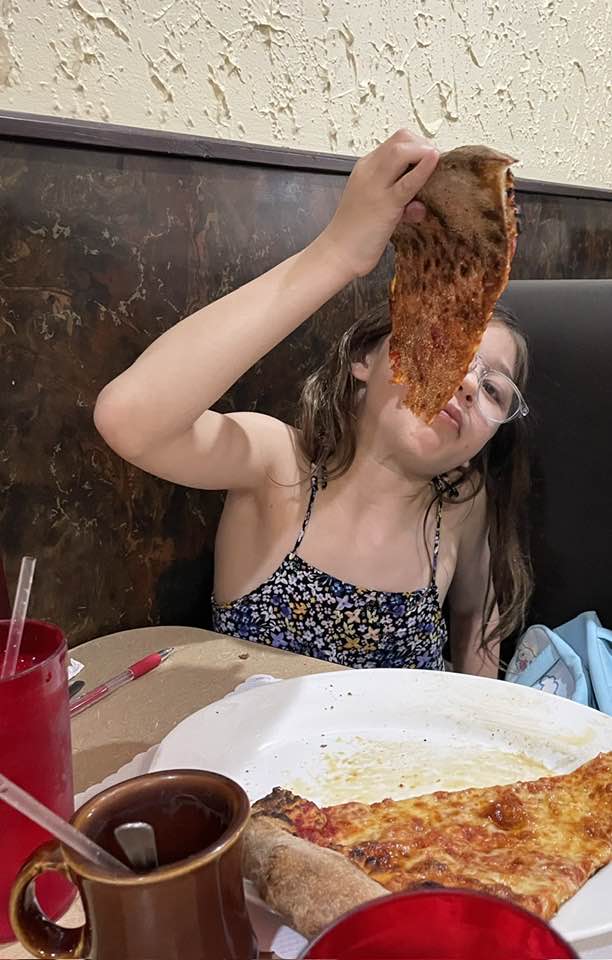
Despite the lack of upgrades in many years, the establishment boasted a menu the size of the Great Plains and enough offerings to satisfy the fussiest eater—kid or adult. The Greek chef and staff knew how to do far more than pizza. My chicken souvlaki was delicious, as was the Greek salad I shared. Illiana feasted on some of the thinnest pizza surely in all of North America.
A short while later, Jenny and Maia swooped in from the dentist appointment and joined the repast. Afterward, we shoved off again, this time to Maia’s wonderful new apartment. After a quick tour, we bade her good-bye and continued to our final destination for the day—Lyme Light on the cove. (Cont.)
Subscribe to this blog and receive notifications of new posts by email.
© 2025 by Eric Nilsson
[1] The former lands of various indigenous people, the Pequot, Mohicans, Paugussett, Schaghticoke the Nipmuc, Wangunk, Niantics, and Quinnipiac tribes (who often fought among themselves); later, the Dutch (as part of “New Netherland”)(1609), until the English showed up (early 1630s) to escape overcrowding back in Plymouth Bay Colony and Massachusetts Bay Colony (after a series of internal tiffs), eventually displacing the Dutch and the indigenous tribes, forming the “Connecticut River Colony” (1636), later joining the short-lived “Dominion of New England” (1686-89), then adopting the “Fundamental Orders of Connecticut” (1689), considered the first written constitution ever, which is the source for the state’s moniker as the “Constitution State.”
