OCTOBER 22, 2025 – I’ve always enjoyed the study of history, but inevitably my principal areas of inquiry—American, European, Russian, Mediterranean, and to some extent, Middle Eastern—have been rather narrow, not to mention shallow. Comparatively speaking, my knowledge of India, China and East Asia is rather abysmal.
Several years ago I caught myself remarking to a friend, “Until one knows a lot about China, one can’t say one knows much about the world.” I later amended this to include India. After reading a riveting book about Africa—The Fortunes of Africa – A 5,000-Year History of Wealth, Greed, and Endeavor by Martin Meredith—for book club, I was compelled to add that continent to the list, as well. After reading William Prescott’s classic, The Conquest of Mexico (a companion to his other classic, The Conquest of Peru), visiting Mayan ruins in Mexico and watching a long Netflix dramatization of the life and times of Simón Bolívar, South America and Central America wound up in the mix as well.
But back to China. Given its territorial size, population, and influence on world civilization, China always loomed largest; the place, the country, the culture that most demanded my attention. Yet for those same reasons, China was most intimidating. The language—cryptic to my Western eyes—was perhaps the highest hurdle. To build a frame of reference, I’d need a grasp of names—places and people—but the most daunting aspect of this necessity was the impenetrable system of Chinese characters. Their Latinized transliteration was of little help, since that system seemed nearly as “foreign” as the undecipherable characters.[1] The rest of things Chinese, except for the standard take-out menu at the local Panda Express, were likewise inscrutable to me.
Then a couple of years ago I read Stilwell and the American Experience in China – 1911 – 1945 by one of my favorite historians, Barbara Tuchman. Capturing the travails and tribulations of General Joseph Stilwell in working with the Chinese Nationalists during the Japanese occupation during World War II, the Pulitzer Prize-winning book (Tuchman’s second Pulitzer Prize) was my first serious foray into Chinese history. Since the setting was the 20th century, the historical period, at least, was well within my frame of reference. The book served as a good introduction to the geography of China, but it revealed little about the ancient land before the Revolution of 1911.
More recently, however, my book club read The Shortest History of China by Linda Jaivin, from a series of “shortest histories” of various countries. It was seductively brief in volume as well as “branding,” but curiously, I found its very brevity to render the subject matter as inaccessible as if it were a far thicker and denser book. If nothing else, however, I learned that “Ming” was long after “Tang,” and that “Tang” came some 800 years after the Emperor Qin Shihuang ordered the construction of his massive mausoleum in Xi’an, including an army of 8,000 (estimated) life-size terracotta warriors, in 246 B.C.E. But to keep straight all the other dynasties, their times in the sun, the catalysts of formation, the causes of decline, the most notable emperors, the highlights of dynastic accomplishments, and low points of bad fortune all soon swirled into murky waters.
Then by chance I encountered the page-turner polemic by Jung Chang and Jon Halliday, Mao: The Unknown Story, followed by Simon Winchester’s riveting tale, The Man Who Loved China and Pacific, another fascinating book by Winchester (See 8/14 – 8/16, 8/18, 8/22 and 9/5 posts). Among other matters, these three books advanced appreciably my familiarity with the basic geography of China.
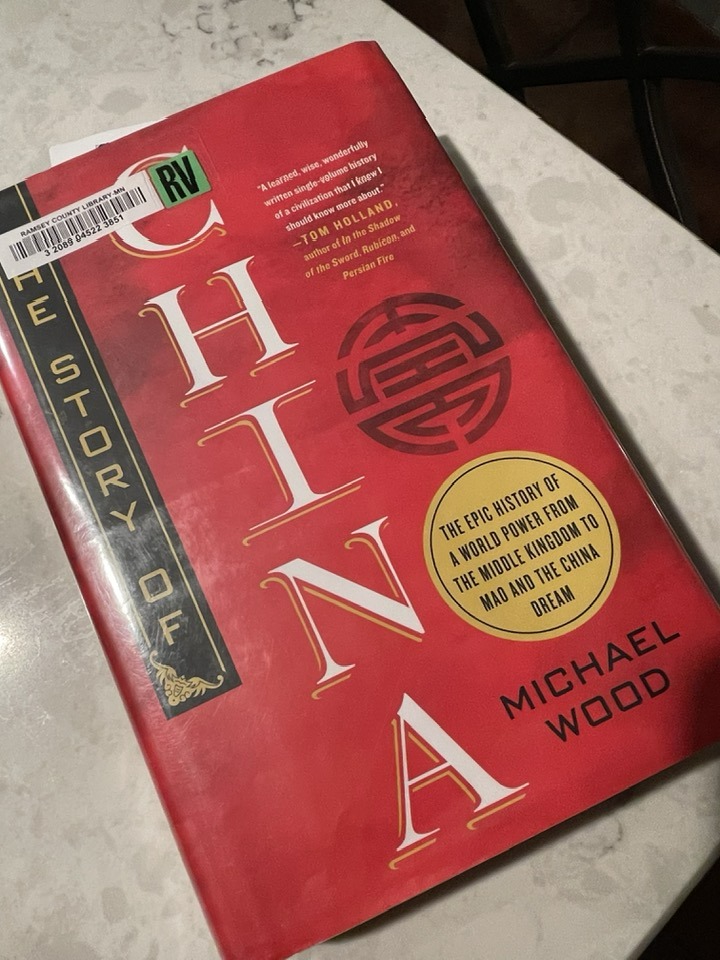
Two weeks ago, I finished reading David Li’s book about contemporary China, China’s World View: Demystifying China to Prevent Global Conflict. This book inspired me to take the deep dive that I’d long been avoiding—the deep plunge into the full history of China. My gateway is The Story of China by Michael Wood, a British historian-filmmaker-documentarian-academic with years of experience in China.
By a variety of means, Wood’s book is high accessible to me, a neophyte, which is not to suggest that the 570-page tome is written for simpletons. It reminds me of the Metropolitan Art Museum: both the Met and the book are wide open to the general public and at all levels of sophistication. Both the museum and the history cover immense territory and must be toured often and with short steps. Whether the subject is the almost infinite visual art on display at the Met or the fathomless 4,000-year history of China, to gain familiarity, knowledge, understanding, appreciation, you need continual and repetitive exposure until general reference points become well ingrained and with each pass, more details become absorbed until, in the case of the Met, an increasing number of paintings, sculptures, et cetera become as familiar as pieces of music you’ve heard a thousand times, and in the instance of Chinese history, it becomes fully integrated into a well-informed world view.
I’ve adopted a new approach to reading fathomless history: one pass through the historical writing equivalent of the “Florence and Herbert Irving Asian Wing” of the Met isn’t enough. Multiple trips are necessary to build a reliable familiarity with the subject matter, geographical and chronological frames of reference, and ultimately, an understanding of the grand sweep of history—the amalgam of influences that shape each definable period. Only after this sort of approach to history can the lessons “stick.”
I must say that this approach—more deliberative than simply turning each page forward and only once—brings the same gratification as travel by foot in a strange land. You might have to take a plane, train, or bus to the place, but once there, to obtain more than a blurry impression, you need to alight from the mode of swift transport and see things up close and at a more observable pace—much as you would when touring the Met.
In due course I shall attempt to summarize how my book tour of China has affected my world view. And next time I’m at the Met . . . I’ll slow my pace and savor each object I see.
Subscribe to this blog and receive notifications of new posts by email.
© 2025 by Eric Nilsson
[1] Ironically, the extensive doodling in my college notebooks took the form of imitation Chinese characters. When an acquaintance saw a sampling of these, he was duly (or unduly) impressed and thought I was fluent in Mandarin. (“You can fool some of the people some of the time, and some of the people all the time . . .”)
