DECEMBER 17, 2025 – I know it’s a mouthful—“MacArthurMAGAburger”—but a mere taste of it can provide sufficient perspective to work as an effective antacid. What am I talking about? The life and times of General Douglas MacArthur, nemesis of President Truman (and democracy), yet the MAGA darling of a bygone era.
Much can be said about the supreme commander of American forces in the Pacific Theater during World War II. In fact, much has been written him, including several lengthy biographies, including William Manchester’s 793-page, American Caesar: Douglas MacArthur 1880 – 1964, which is widely regarded as a fair and balanced treatment of a brilliant but hugely flawed character in the pantheon of historical American movers and shakers.
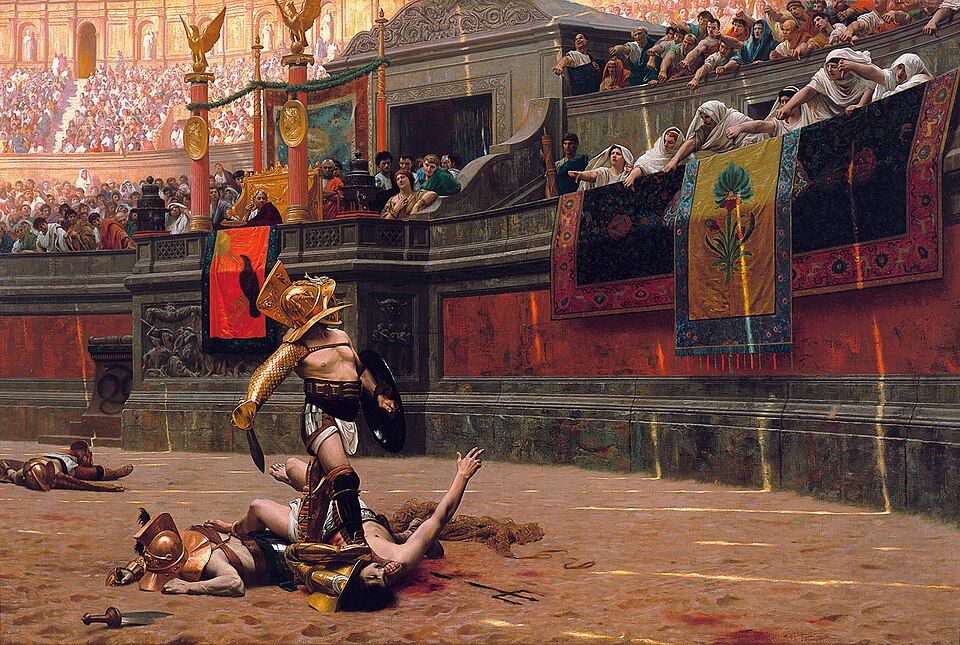
I’ve not plowed through any of these tomes, but I have read a fair amount about MacArthur in various other books about World War II and the Korean War. As a result of what I do know about MacArthur—from best to worse—if I were a Roman in the Colosseum watching a fight between gladiators cast as Truman vs. MacArthur, I would join those spectators who in the pollice verso signal “mercy” for the defeated MacArthur.[1] If I were a senator, I would then vote for his banishment from Rome . . . and exile to St. Helena. Yet, in recognition of MacArthur’s achievements, I would concurrently vote in favor of funds to erect two monuments in Tokyo: one on the grounds of the U.S. Embassy in honor of the general’s winning (as it turned out) strategy in World War II (i.e. isolating, not attacking, Japanese strongholds) and another in front of the Japanese National Diet Building (home of the two houses of the National Diet (Japanese Parliament)), honoring MacArthur’s hand in democratizing Japan after the cataclysmic war.
But back to the “MacArthurMAGAburger.” In my current plunge into The Coldest Winter: America and the Korean War Dave Halberstam’s acclaimed history of that conflict, I’m revisiting not only MacArthur’s role in Korea but his much broader part in American military and political history. This time around, the parallels between the “American Caesar” and another vainglorious autocrat—Donald J. Trump—are unmistakable.
Don’t get me wrong. In myriad ways, the general stands head and shoulders above the charlatan: the former was intellectually brilliant, whereas the latter is observably not; the general can be credited with the two positive achievements noted above, but the charlatan has done nothing constructive in a life of breaking lots of china.
The parallels are far more numerous, notable and instructive. MacArthur lived in the shadow of his equally egotistical father. Ditto Trump. MacArthur was first and foremost a political grandstander, who defied direct orders, conventions, and decency to win the spotlight and personal power. Ditto Trump. MacArthur dodged accountability for his (hugely consequential) screw-ups. Ditto Trump. MacArthur was an overt racist, anti-Semite, and incorrigible bigot. Ditto Trump. MacArthur drooled over the prospect of becoming president—for the sheer power of it. Ditto Trump. MacArthur surrounded himself with sycophants and one-way loyalists. Ditto Trump. MacArthur never cultivated a true friend. Ditto Trump. MacArthur was unremittingly contemptuous of lesser men—and in his full-on arrogance, everyone was by definition, a “lesser person.” Ditto Trump. Isolationists flocked to MacArthur. Ditto Trump. Millions of Americans wanted MacArthur as their Führer. Ditto Trump.
My point here is that as much as we might lament the horrible damage wrought by a Trump presidency and the unsettling prospects that three more years of his cruel, corrupt, indecent, and incompetent regime could bring, his case is not unique in our history. If MacArthur never became a full-fledged Caesar of the American Empire (doubtless his view of the presidency, not unlike Trump’s), he wielded immense power for an extended period—so much so, President Truman risked political defeat, even impeachment for firing MacArthur. The general’s super-star, war-hero status led to an enormous following, which was in many respects a forerunner of today’s MAGA crowd—including Republican Congressmen and Senators.
By no means does the fact that we survived “Caesar MacArthurus” suggest that we should bide our time in the face of current assaults on the traits and principles that shape our national “exceptionalism.” We must continue to resist and react in every constructive way we can. But the example of MacArthur should give us hope and fortitude to carry on, to seek out what is good and right and eschew what is bad and wrong. We can do this, people, if we emulate our forebears who managed to overcome potentially game-ending threats in the past.
Subscribe to this blog and receive notifications of new posts by email.
© 2025 by Eric Nilsson
[1] Great confusion and debate fills the historical record regarding the “thumbs up,” “thumbs down” signal (pollice verso, meaning “turned thumb” in Latin) given by spectators at Roman gladiator fights. Hollywood has adopted “thumbs up” for “Let him live!” and “thumbs down” for “Kill him!” but it could well be that the meaning of these gestures (and other gestures deploying the thumb) were the opposite of what has been directed by filmmakers. The filmmakers’ source, in turn, can be traced to a painting entitled Pollice Verso by the French artist, Jean-Léon Gérôme in 1872, in which depiction of the pollice verso is arguably wrong.
