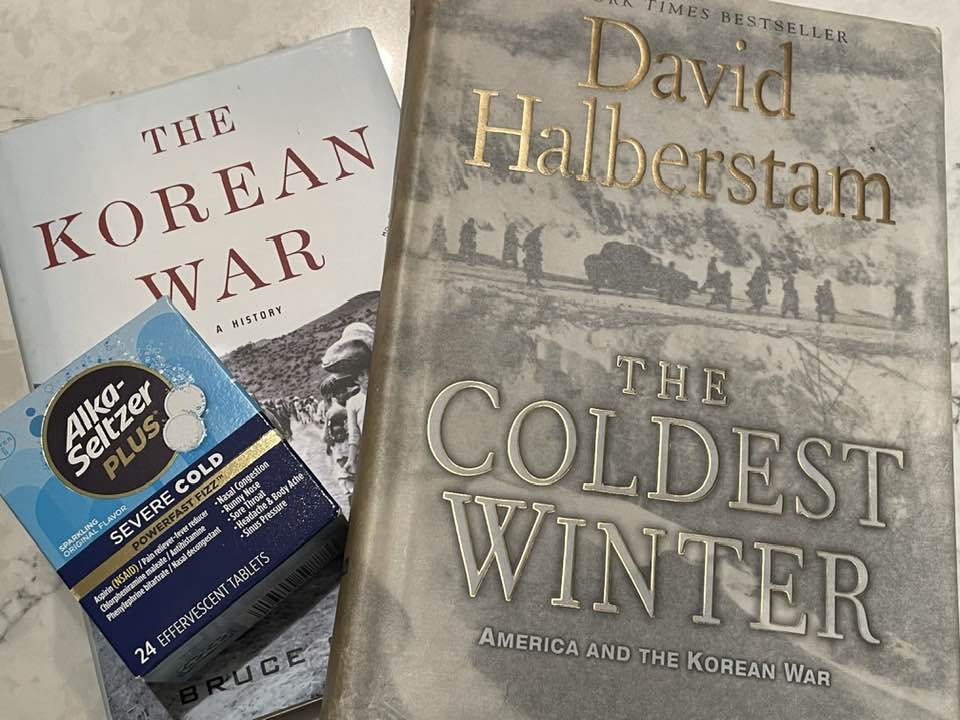
FEBRUARY 27, 2026 – (Cont.) At the Brushmill I’d been torn between the chicken pot pie and the red lentil soup to go with my half of the misticanza salad that Byron and I had ordered together. Ultimately, I’d gone with the soup, thinking it was the more healthful choice, but then again, as everyone with a grandmother knows, chicken soup is the best way to wage a cold war, ergo (surely) a chicken pot pie is the next best way. And by the embellished description of the pot pie, you knew it wasn’t from the frozen dinner section of Adams Grocery in Deep River—you know, the two for $5 (if you’re a “member”) version with 9 grams of saturated fat per pot pie and instructions to poke holes in the crust before baking to avoid a pot pie explosion inside your oven, which mishap will cost you $25 in cleaning agents to scrape clean, but then in compliance with the directions to avoid the explosion, you wind up forcing your spouse to call you an idiot after you’ve bent the fork tines because the frozen pot pie is as hard as granite in New Hampshire in January.
So. Anyway. Where was I? Oh yeah: By the time I’d normally be dozing off, I was hacking so hard, I knew I should’ve chosen le torte au poulet extraordinaire. Because of my wicked cough, I’d been consigned to my own room—left to cough my lungs out, blow my nose like a howitzer, and moan and groan over my bitter fate fighting the Cold War all alone. As far as I was concerned, this isolation was at best a half measure. It provided the rest of the household some insulation from the booms and blasts of Cold War combat, but it offered me absolutely no succor whatsoever; no relief from . . . myself.
After finally, finally, coughing up the equivalent of a feline hairball, I crawled into bed, put my readers on and opened my latest bedtime story, The Korean War by East Asian/Korean scholar Bruce Cummings. Except, the book isn’t so much about the war itself—the first “hot” conflict of the Cold War—as it is about American ignorance of “Land of the Morning Calm”; the internecine conflicts within Korea (fanned by the U.S.) in the years leading up to the war (June, 1950); the role of Korean collaborators during the Japanese occupation; and the “Forgotten War’s” influence on American post-World War II (misguided) foreign policy and crusade against “world communism.” It’s all enough to turn your simple side of miso soup into an entree of swamp water gumbo.
I’d been adequately distracted by this history of the Cold War, when a new front opened in my personal cold war. Now, I noticed, my jaws, my teeth ached. Some cold, alright; some war. I closed the book on the Korean War, put out the reading lamp and turned on my side on the pillow ramp I’d constructed earlier at the head of the bead. The idea was to let gravity help drain my sinuses, which in the course of my cold war had become a reservoir of a four-letter word that rhymes with “fraught.”
In the darkness, thinking of my sinuses as a “reservoir” reminded me of the Battle of Chosin Reservoir in the Korean War. That engagement was one of the most miserable military debacles ever suffered by American soldiers. Pinned down by endless waves of Chinese and North Korean troops, the Americans came undone. The weather was brutally cold—heavy snowfall followed by sub-zero (Fahrenheit) temps—in what for Korea was one of the worst winters on record. The catastrophe occurred soon after the five-star prima donna in charge (from the safety of his headquarters back in Tokyo), General MacArthur, had promised “our boys would be home for Christmas.” In hindsight, the glaring omission had been the year of said Christmas.
As I hacked away in this fetal position in the dark of the Connecticut night, I imagined myself as one of those poor G.I.s back then, frozen to the ground, curled up under my own blanket and one from a fallen comrade, my hands worked into fists inside my mittens wrapped, in turn, around the barrel of my M1 Garand. I couldn’t remember the last time we’d been given anything resembling a hot meal—let alone a chicken pot pie. Then there were the dead and wounded all around us. Nothing could be done for them.
The worst of it was that the order had gone out: just before daybreak, we were to pick up and climb through heavy snow straight into enemy lines to “take the ridge.” Whose brilliant idea was that? Yet given our misery, which no one back home could begin to understand, maybe the order was a blessing in disguise—a ticket out of this otherwise inescapable evil madness. But who was responsible for this insanity? This abject failure of humanity?
These macabre thoughts morphed into a bad dream, as I slipped into sleep mode. The world as I knew it was coming to a grievous end, but chained to the earth, I couldn’t separate myself from it, except by supernatural will.
As happens in dreams, I’d somehow turned—or coughed?—in my sleep and somehow flipped the switch to a new venue; one free of evil and distress. Beth and I were seated, squeezed in, really, on the side of some kind of storeroom in the back of a shop in modern Seoul. A table occupied nearly the entire floor space of the room and bore an astonishing heap of packaged spices, condiments and delicacies, all in containers round and square wrapped in tightly controlled explosions of intensely bright colors. I imagined a miniaturized fireworks factory set afire, then loaded into a kaleidoscope, wherein everything fell into place and held still. Meanwhile, hanging around the periphery of the room were lots of beautiful hanboks, similar to the ones that in reality Seng Hee, Byron’s “K-mom” has so lovingly bestowed on Cory’s daughter, Illiana, and on Dio with another, surely, when his little sister reaches the age of one—or, as Korean’s count, two.
I woke up and reached for the roll of TP, then coughed and blew my nose, of course, but also to ponder my dreams. I thought of our family’s Korean connections—gems, jewels and pearls from the same place that has produced such atrocities and unspeakable suffering. My dreams then, reflected the same dichotomy—the worst of the worst and the best of the best, not simply of Korea but of humanity.
I got up and moved to one of the windows and looked out at the snow-covered yard and trees, the street below, and the house on the other side and down the hillside, with its outside front portal nightlights providing a hint of gentle warmth to the quiet wintry scene. All seemed right with the world, despite my . . . cold war.
But what of the realities depicted in my dreams? Where else in the cosmos could such comparable conditions be found? Nowhere, I’m sure, yet how could I possibly be sure? I coughed, blew my nose again, then slipped back under the covers. Somehow I fell asleep—until the dawn’s none too early light filled the room and the scampering feet of a toddler could be heard chasing down the hallway.
Subscribe to this blog and receive notifications of new posts by email.
© 2026 by Eric Nilsson
