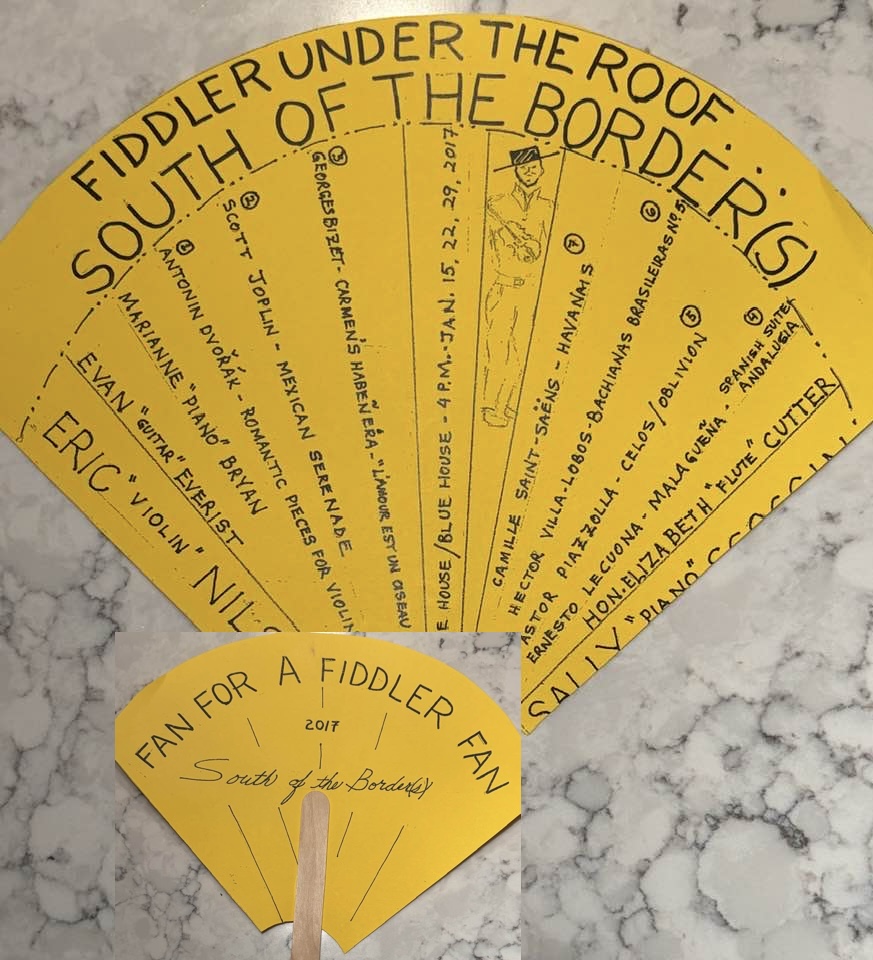
MARCH 18, 2026 – Over the decade from 2009 to 2019, Sally Scoggin and I practiced law; separate firms, different practice areas but the same daily grind of . . . “billable hours.” During that same decade we spent many hundreds of additional hours—entirely non-billable—practicing repertoire for our annual “winter house concerts,” dubbed, “The Fiddler UNDER the Roof.” Along the way, we recruited other musician friends to the fray—most notably, our law school classmate and co-conspirator, the Hon. (ret.) Elizabeth Cutter—but the central effort was our violin and piano duo. Undaunted by my deficiencies, Sally and I worked as hard as we knew how, first to conquer, then to refine our program repertoire. Our musical project concluded in February 2019 with our 10th set of concerts, which featured the world premieres of music commissioned especially for us. Afterward I sent an email to our more than 200 fans thanking them for their loyal support over the years and informing them that I was taking a breather to start a new venture: this blog.
Then came Covid. Then came my diagnosis of multiple myeloma. Then came the worst: Sally’s husband, Don, diagnosed with liver cancer. An extraordinary member of the human race and our in-residence coach, Don left this world as the 2023 calendar ran out—way before his time. (See 01/01/24 post). “Fiddler UNDER the Roof” faded further into the past.
Today Sally and I reassembled in the living room of Sally and Don’s gracious home a short drive down into St. Paul. As I opened my violin case, a flood of memories surged forth: Sally at her vintage Steinway—refurbished at the Steinway factory in New York—and I at a music stand; Don often about, rehearsing with his folk band, Stealin’ Home, in the basement or writing poetry upstairs, sometimes reciting for us after our rehearsals.
A PhD child psychologist at the University of Minnesota, Don was one of those people who excelled at everything he pursued, and his pursuits were numberless, it seemed. He could well have been defined by any one of his many gifts, but what defined him best was his ability to listen to, understand and connect with people.
He was a connoisseur of all genres of music, and his understanding of the Western classical repertoire—Baroque to contemporary—was as encyclopedic as the knowledge base of any music scholar. His gentle, insightful suggestions for Sally and me were always delivered with perfect pitch.
Though we’d seen Sally at a recent social engagement—one of the homes where we played our concerts—honoring a mutual friend, we hadn’t had a chance to talk much beyond the surface. Today, we caught up on our respective (shared) reactions to all the changes in the world since we’d last had a chance to discuss them.
Eventually, we got around to our stated purpose: rehearsing a short piece that I’ll be performing on the program of the memorial service planned for my upcoming 50th college class reunion. I’d settled on the first of a collection of four pieces by Antonín Dvořák called, “Four Romantic Pieces for Violin and Piano.” We’d performed it on our 2017 program, which was entitled, “South of the Border(s).”
We’d had a blast with the theme that year. I dressed up in a Zorro outfit, courtesy of the inimitable Cliff Witmyer, owner of Fun Ghoul, and “our man on the ground” in Rutherford, New Jersey. (See Inheritance series on this blog site – May to September 2023). The “borders,” all south of wintry Minnesota, were Iowa (I’ll come back to this), Missouri (Scott Joplin – Mexican Serenade), Cuba (Camille Saint-Saëns – Havanais), Brazil (Hector Villa-Lobos – Bachianas Brasileiras No. 5), Argentina (Astor Piazzolla – Celos/Oblivion), and for an overall old world flavor, Spain (George Bizet – Carmen’s Habeñera – “L’amour est un oiseau rebelle” and Ernesto Lecuona – Malagueña – Spanish Suite – Andalusia).
What I chose for the first border crossing—into Iowa—was the Dvořák piece mentioned above, a sweet sampler of the Czech composer who’d spent a summer in Spillville, and even traveled up to St. Paul.
Today for the first time in nine years, we played this short lyrical piece, a miniature daisy in Dvořák’s flower bed of tiger lilies, dahlias, and hydrangeas—“war horse” concerti, symphonies and full range of chamber music.
Extricating myself from work calls before leaving the house for Sally’s had been challenging. Moreover, they’d consumed the time I’d reserved to warm-up ahead of our rehearsal. I’ve never been able to play “cold,” even in the middle of a summer hot spell. I need to play through scales, arpeggios, maybe a little Bach, not to mention the piece or pieces to be rehearsed.
Our first run-through left me disappointed in myself, even accounting for playing stone “cold.” Sally did just fine, but I’d failed to “connect” with the piece in the way I’ve been doing lately in practice sessions at home—after sufficient warm-up. We had plenty of latitude, however, to repeat the three-minute-long piece as many times as we needed or wanted to. With each pass, color and warmth increased.
We chatted for a bit, and I described the venue—the Bowdoin Chapel, a notable architectural feature of the campus. Suddenly, Sally’s eyes lit up. “The Bowdoin Chapel?” she asked. She knew of it, and not simply because her son Will had gone to school within reasonable proximity of Brunswick—Bates College up the pike in Lewiston, Maine. It turned out that Sally is an acquaintance of the granddaughter of the architect overseeing renovation of the Romanesque-style mid-19th century chapel some 25 years ago.
“Okay,” I said. “Let’s go through it again and treat it as if we’re playing at the dress rehearsal.”
After the last note had faded from the room, Sally lifted her hands from the keyboard, looked at me and smiled. “Now I’m hearing the warmth!” she said “But . . . Make it warm and tender. I know you can do that. I mean right here . . .” She directed me to the couple of measures before the first repeat. “That’s so beautiful as it plays out—like putting a baby to bed.”
“Ha!” I said. “I love that image. It fits perfectly—putting a baby to bed.”
As Sally commented on another phrase, I stole her pencil off the piano and wrote in large block letters at the top of my music, “WARM AND TENDER!” Over the phrase she’d singled out, I wrote, “Putting the baby to bed.”
“Okay,” Sally. “One more time—the real deal. Let’s pretend it’s now the actual service and a bunch of my classmates are waiting, ready to listen.”
It was our best rendition of the session, and Sally gave it convincing approval. She added that she thought it was the perfect selection for the memorial service.
As I packed up my fiddle, I told Sally how very, very much I appreciated her meaningful effort and willingness to accommodate me. “We can practice this as much as you like before your reunion,” she said, graciously.
“That would be great,” I said, “and maybe we can expand the repertoire and get back to a regular schedule.” I reminded her of an old idea to assemble a program consisting of the more playable excerpts of half a dozen “war horse” violin concerti. “‘Bits of Pieces’ we’d call it,” I said. “It would be fun to work them up.”
“That would be fun,” she said, with her customary enthusiasm.
And who knows, maybe we could play them for a “full house” audience, just like old times.
Stay tuned, my friends . . . and in tune.
Subscribe to this blog and receive notifications of new posts by email.
© 2026 by Eric Nilsson
