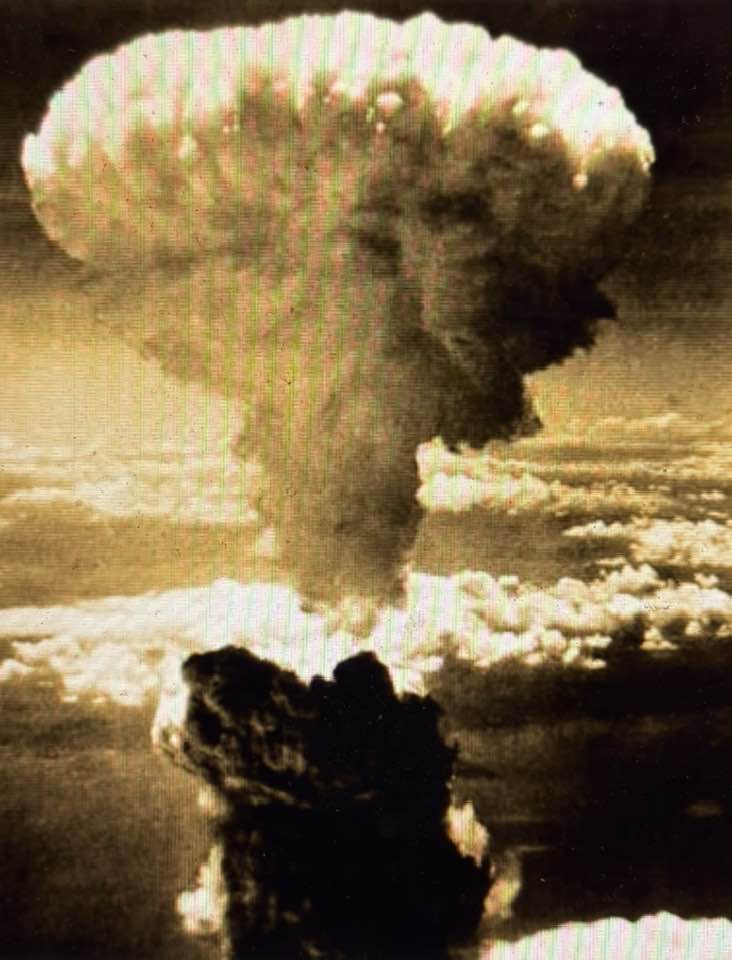
MARCH 15, 2026 – Somewhere along the line of my secondary education John Hersey’s book, Hiroshima was required reading. As our nation’s foolhardy leader drags us into yet another war, Hersey’s account of six survivors of the blast that was “brighter than a thousand suns” should again be required reading.
The “book” was an article published in the August 31, 1946 issue of The New Yorker. In fact, apart from the regular feature, “Goings on About Town” and the movie listings, the article was the issue—the entire issue. In short order, the 300,000 copies of the magazine sold out. The article was reprinted throughout the world wherever at that time newsprint wasn’t rationed—as it was in the UK, where the BBC broadcast a reading of Hiroshima in its entirety.
John Hersey had been a famous war correspondent, who after the war became a staff writer for The New Yorker. He’d been commissioned to travel to Japan to report on the city that had been wiped off the surface of the earth a year earlier by the power of nuclear fission unleashed by a tiny group of scientists, military men and civilian leaders. His original plan had been to focus on the devastation and the state of rebuilding. En route by sea, however, he wound up in sick bay, and to pass the time, he was given a copy of Thornton Wilders’s book, The Bridge of San Luis Rey. The Pulitzer Prize-winning novel portrayed the lives of five people who died when an ancient Inca rope bridge in Peru gave way. The story influenced Hersey to change his own focus to six survivors of the Hiroshima bombing.
The first atomic bomb was a quantum (pun fully intended) leap in the history of warfare. Never before had any single device unleashed such awesome immediate destruction. Moreover, radiation from the bomb caused the death of many thousands of people after the initial blast.
Hersey’s reportage on the level of human suffering shocked his readership and underscored the stark warnings of the scientists who’d worked on the first atomic bombs—many of whom petitioned Truman not to deploy them. But within months of the Japanese surrender shortly after the second atomic bomb was detonated—over Nagasaki—the nuclear arms race was on. The terrible power of nuclear weapons still haunts the earth, as recent events have underscored.
Yet, we didn’t need to unleash the secrets of the atom to access the depths of hell. Five months before the atom bombs vaporized Hiroshima and Nagasaki, the fire-bombing of Tokyo had killed an estimated 100,000 people, injured another 125,000 and left a million people homeless. Prior to that were the fire-bombings of Pforzheim, Dresden and Hamburg, the rape of Nanking, and of course, the slaughter of six million Jews across Europe. Despite the Geneva Convention, atrocities were the hallmark of World War II.
Because of the scale and nature of suffering involved, advent of atomic weapons represented what would later be characterized as a “paradigm shift” in the conduct of war; a transition from merely “unimaginable” destruction to our potential self-extinction. What’s worth continual re-examination is the Faustian bargain that accompanied deployment of the A-bombs over Hiroshima and Nagasaki. The stated rationale was to avoid the loss of hundreds of thousands of American soldiers in an invasion of Japan—the inevitable alternative to the bombs—though it can be argued with equal force that the real target was Josef Stalin as much as it was several hundred thousand Japanese. In either case or both, the Faustian factor was the same: in exchange for immediate victory over Japan—and strategic advantage against the Soviets in the post-war world—we were mortgaging humanity’s future in perpetuity.
The impetus for my inquiry into Hersey’s book/article, Hiroshima, was my recent discovery of a an intriguing three-hour 1995 docudrama also called Hiroshima. This latter work, produced jointly by Canadians and Japanese documentarians and filmmakers features a mix of historic film footage, interviews and dramatization depicting deliberations within the Truman Administration over the decision to use the “nuclear option” and debate inside the Japanese government regarding surrender.
Viewed from the perspective of over eight decades since the bombs were dropped and Japan’s subsequent surrender and against the backdrop of Trump’s potentially cataclysmic war against Iran, Hiroshima—both the book/article and the docudrama—warrant a renewed case of “second guessing.” (Cont.)
Subscribe to this blog and receive notifications of new posts by email.
© 2026 by Eric Nilsson
