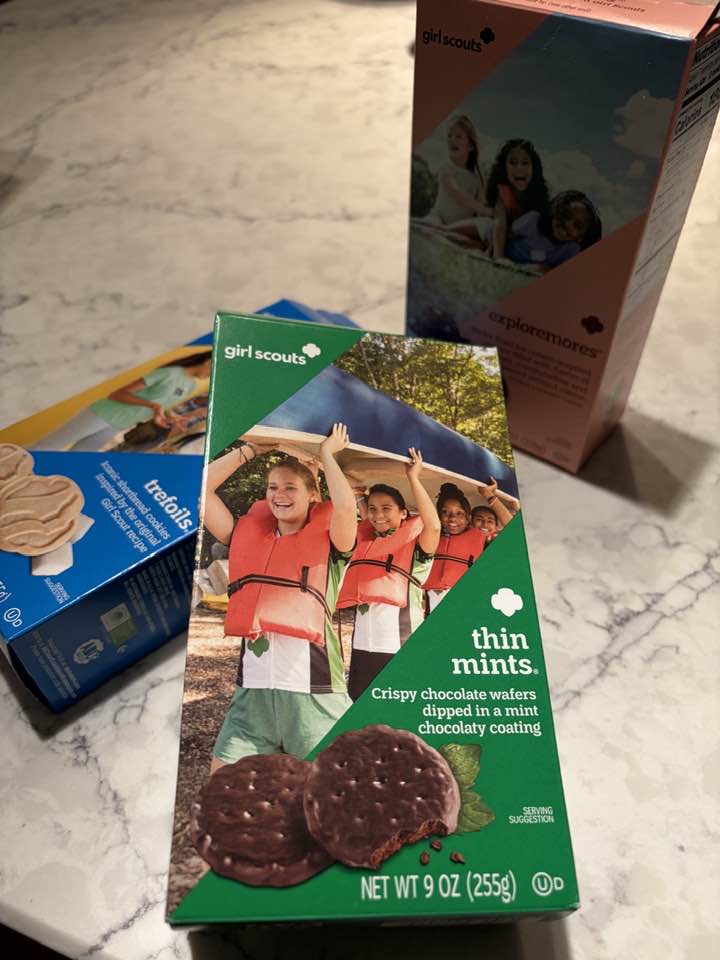
MARCH 13, 2026 – This evening we enjoyed dinner out with our good friends Jim and Bonnie. Manitou, the popular spot in downtown White Bear Lake, was royally hopping in anticipation of St. Patrick’s Day, just four days away. Just as we were finishing our meal, a Girl Scout in full regalia started making the rounds among the crowd of patrons to sell perennial Girl Scout cookies. The girl’s dad kept tabs on the inventory stacked high behind a nearby pillar. When the Girl Scout solicited our table, Beth politely explained that she, Beth, had already made our household purchase from a neighbor, but having been a Girl Scout herself, Beth opened up a conversation with the girl and asked about all the badges sewn onto the Cadette’s sash.
As they chattered away, I leaned toward Jim and said, “Wanna hear my Girl Scout story?”
“Sure.”
This is the story I told:
My oldest sister was in Girl Scouts, and when she was 15, her troop was preparing for a spring break trip to the big Girl Scout camp in Cuernavaca, Mexico called, “Our Cabaña.” A large part of the cost was funded by the troop’s cookie sales. For days before the departure date, all my sisters and her friends could talk about was the upcoming adventure. To get there, the westside Anoka Girl Scouts and their chaperones took a Greyhound bus—from Minneapolis. The total driving time was around 40 hours, covering over 2,100 miles, which explains why our mother didn’t volunteer to be one of the chaperones.
While the Girls Scouts were living it up south of the border, the spring snow melt following a winter of record snowfall brought major flooding along the Mississippi River which flowed past our neighborhood in Anoka. I’ll never forget the early Saturday morning when everyone was still in bed and the doorbell rang repeatedly. My bedroom was at the top of the stairs, so I, a 10-year-old, was the first one to the front door. By the time I’d wrestled open the door, however, Dad in his pajamas was standing right behind me. On the other side of the storm door was a stern-faced police officer. He didn’t wait for us to invite him in.
“There’s an ice-dam downstream,” said the officer, as he pulled open the storm door. “It’s backing up the river—you can see it rising already in Caine’s lot right across the street.”
Dad and I looked where the officer was pointing, and sure enough, the icy and turbulent water of the Mississippi River was rushing into the vacant lot. Soon it would pour over the curb and into the street.
“By noon,” said the cop, “the water will be up to here.” He used the edge of his hand to mark a place on the door frame about three feet above the threshold. “You’ll need to get everything out of your basement and first floor.” He then looked at his watch. “You’ve got about four hours.”
I never saw my parents move so fast. Mother called friends and friends of friends for help while Dad changed into work clothes for the Herculean task that nature had foisted upon him. Soon a small army of helpers were on hand carrying every movable object from the endangered areas of the house to higher elevations.
Among the goods were the china, crystal and porcelain from the dining room cabinets. Mother did her best to oversee the process, wrapping the more fragile and valuable items in newspaper and whatever else she could lay her hands on. She commandeered boxes and baskets from the garage, basement, attic and packed them full with the wrapped china, etc. She then directed the volunteers to carry the mix of containers upstairs to . . . my oldest sister’s bedroom.
Down river, meanwhile, explosive experts had dislodged the ice dam, and before the Mississippi could rise into our yard, it receded to a less threatening level. Over the next several days it would rise again, but it never flooded our house.
Although everything had been cleared out of the basement and first floor in fast motion, the reverse operation was a far slower process. By the day of the Girl Scouts’ scheduled return, the dining room china, crystal and porcelain remained in place upstairs.
The Girl Scout bus was to arrive at the Minneapolis depot in the evening well after dark. After supper Mother and Dad left the house to make the 45-minute drive with ample room to spare. To make room in the car for my sister and at least a couple of her friends, my other two sisters and I were left behind.
An odd combination of boredom and desire to extend a favor to my mother spawned the bright idea to carry all the valuable dishware and crystal back down to the dining room and restore the cups, saucers, fancy glasses and so on to their proper places in the main buffet. Except . . . I couldn’t keep it simple. I’d never much cared for the way Mother stored things behind the glass doors of the buffet. In my opinion, things should be displayed with more elegance.
I went to work with great enthusiasm. After an extended effort, everything was in place just as I thought it should be. I couldn’t wait for Mother to see it. The flood crisis had been quite stressful on her, and I figured that she would appreciate not only my initiative, but my efforts to enhance the display of her fine things stored in the buffet.
I closed the glass doors and stepped back for a final review of my grand work. I noticed, however, that one saucer, resting on edge, had rolled an inch or two and was now off center vis-à-vis the cup standing in front of it. It was a simple thing to remedy, I thought. I then reached to open both doors of the buffet to allow optimal access to the errant saucer. Unfortunately, the general humidity was high, which had led to a swelling of the buffet door frames. They’d required some pressure to close. Now, to open them again, took equal force in the opposite direction. I had to tug in earnest.
Suddenly, the doors opened but with such unanticipated force, the motion sucked things right out of the buffet. In horror I watched Mother’s finest things fly off the shelves and crash onto the bare oak floor of the dining room. The din hurt my ears and left them ringing for the next five minutes.
In a panic, I grabbed a broom and dust bin out of the pantry closet and swept up the remains of Mother’s collection of “nice stuff.” After spreading the ruins out on the dining room table, I fetched a bottle of Elmer’s glue and set about gluing together what I could. This was the scene that Mother entered a half hour later.
To her credit, she didn’t scream, yell or faint. After I explained what had occurred, she calmly said, “I’ll forgive you if every Christmas you get me a Danish plate—Royal Copenhagen.”
And so I did, and each year Dad would hang the latest plate along the ever-expanding horizontal row along the top of the dining room walls. After about 25 years, Mother finally said, “Thanks, but you know, I don’t think I need any more of these.”
All of which is why to this day, I associate Girl Scouts with the great spring flood of 1965, its disruptive effect on our household, and my bungled restorative efforts on the night of my sister’s return from “My Cabaña” deep down in Mexico. You might say that for me, it’s how the Girl Scout cookies crumbled.
Subscribe to this blog and receive notifications of new posts by email.
© 2026 by Eric Nilsson
